Hi everyone, I was going to turn the spotlight of this local history post on Corning’s grand old hotel, The Dickinson House; and I will talk about that in a moment – first though, I want to note the passing of educator and historian Thomas Dimitroff who died yesterday.
As you probably know Thomas Dimitroff taught history locally for decades; indeed he was teaching at the middle school version of C.F.A. when I was there; he wrote books on the Houghton Family, Frederick Carder and Steuben Glass and more; including a book he co-authored with fellow C.F.A. teacher and historian Lois Janes, which is the book I recommend to anyone/everyone stopping by the library and looking to learn about the history of our region – History of the Corning-Painted Post Area: 200 Years in Painted Post Country.
Sadly, Mr. Dimitroff died yesterday, and it was announced through the Carder Steuben Glass Association, of which he was a founding member, this morning, here is the link:
In his honor I suggested taking a look at one of his books – if you don’t already have one – stop by the library and check them out –
And getting back to the Dickinson House, it was a large, grand hotel which was very fancy for the small village of Corning, New York, when it first opened. It was located on what was then Pine Street Square and is today Centerway Square; it was built by Andrew Bray Dickinson and Hiram Bostwick and officially opened with a dedication ceremony on September 24, 1851; one hundred and seventy-five years ago today!
Andrew Bray Dickinson is himself a notable local, in addition to helping to finance and build the Dickinson House, he was a state senator, the first Town Supervisor of Hornby, N.Y. and U.S. Ambassador to Nicaragua. He is also a member of the Steuben County Hall of Fame. And he had very little to do with running the hotel named after him after it was opened – the most notable people to run the hotel were two brothers; George & Dwight Fuller who ran the hotel for 44 years – and that is another story for a later date! As really is the story of both Mr. Dickinson and his partner Hiram Bostwick – who both lived interesting lives.
Getting back to the Dickinson House, for a more in-depth history of the hotel, check out the Leader articles listed below; and for those who appreciate brevity, here is a short history:
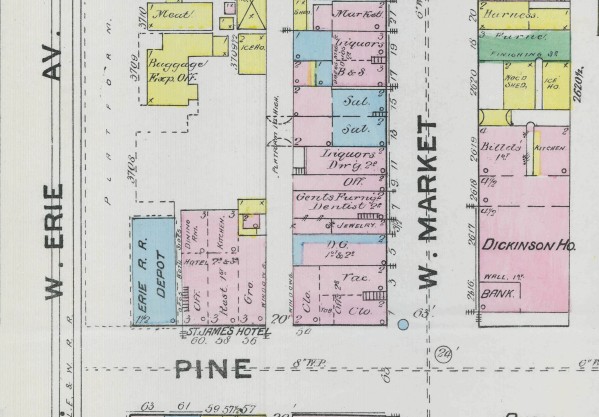
Corning had been incorporated as a village in July of 1848, and the village then had a population of approximately 3,000 (Dimitroff-Jaynes, p25). Corning was situated in a great location for travelers to stop and goods to travel through; being connected both to the Erie Canal system by the Chemung River, via the nearby Chemung Feeder Canal; and to the railroads; most notably the Blossburg, Corning & Tioga Railroad and the Erie Railroad, which had tracks right down Erie Avenue (Denison Parkway) in Corning (Dimitroff-Janes, p81-83.) In fact, the Erie Railway Station was located on the corner of Pine and Erie Avenue, just one block away from Pine Street Square. (See the close up of the 1888 Sanborn map of Corning below for more info.)
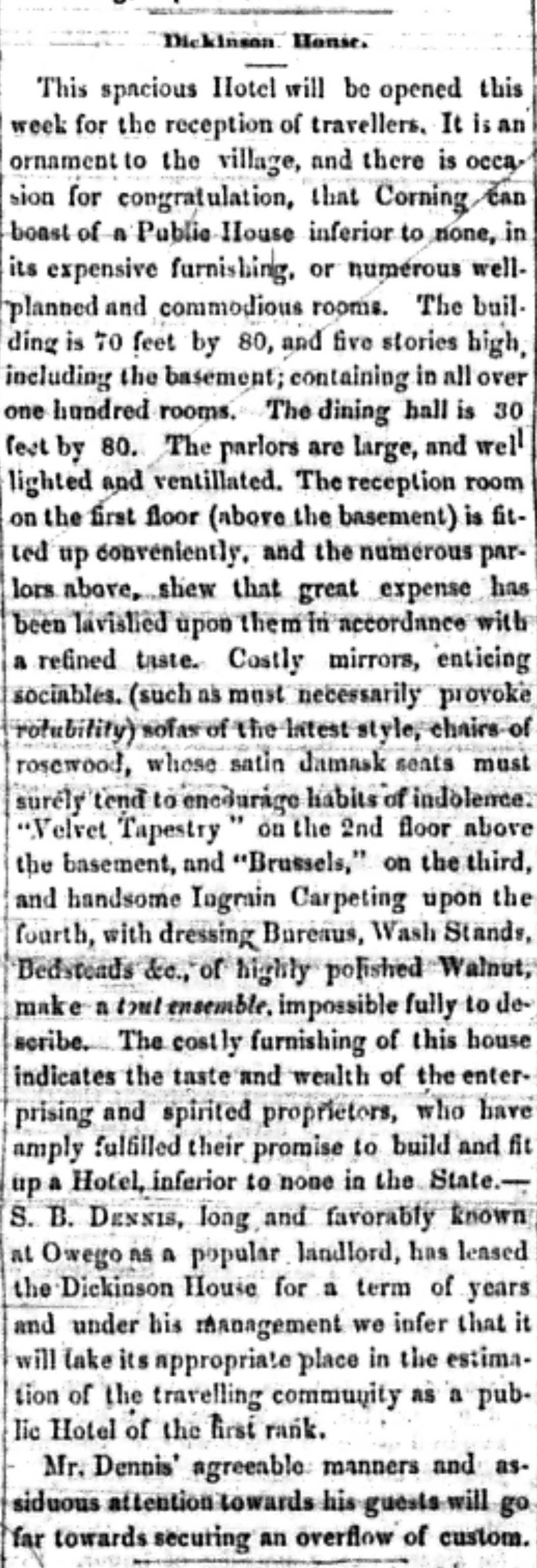
So, in 1851 Corning was a jumping transportation hub and a place for travelers to stop on their way to far off destinations. And with that in mind, Dickinson and Bostwick built their grand hotel on Pine Street Square. The hotel featured five floors, 100 spacious rooms, a huge dining hall, multiple parlors and a lobby with a tiled floor and intricate oak woodwork. The building was lavishly furnished too; and featured large mirrors, ingrain carpeting, high-end stylish sofas, rosewood chairs and velvet tapestries; it was well light and ventilated too – ventilation being a concern in the days before air conditioning technology made its debut.
The grand old Dickinson House was a mainstay in Corning for decades hosting many visitors and gatherings over the years, but time marches on as it always does; and in 1927 the Corning Hotel Corporation purchased the property, demolished the old hotel, which closed its doors in May 1927, and built a newer more modern hotel in its place – the Baron Steuben Hotel. The hotel building still stands although it is no longer a used as a hotel, but it is still in use – the Old World Café is the most visible business in the building, being located on the corner of the ground-floor adjacent to Centerway Square. (Elmira Star-Gazette, 5.6.1927)
So, the next time you walk or drive by the Baron Steuben building take a minute and remember its predecessor the grand old Dickinson House! (and think of all the history that unfolded within its walls!)
Have a great day,
Linda Reimer, SSCL
The Dickinson House: Articles & Photos
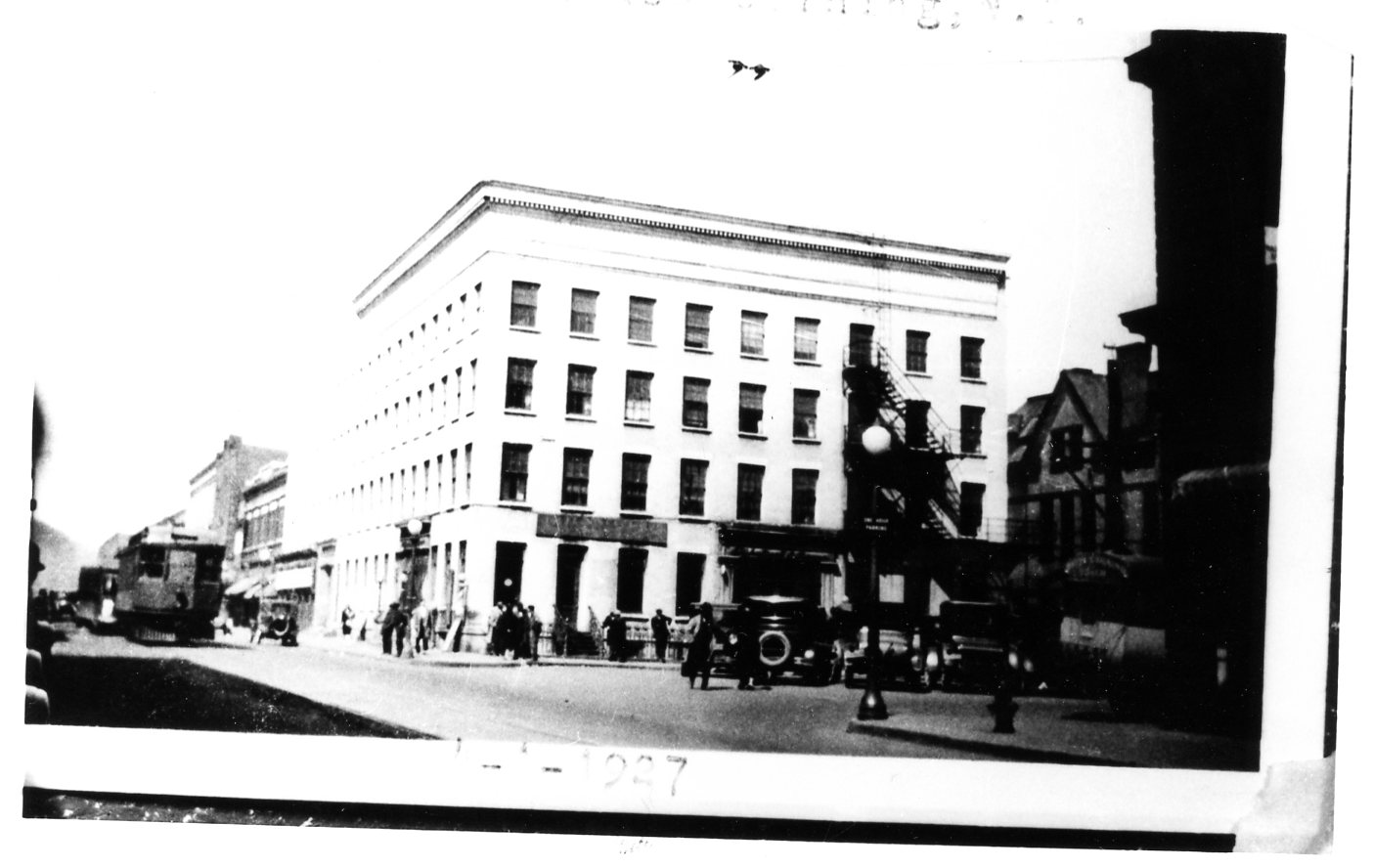
The Dickinson House (circa 1920s)
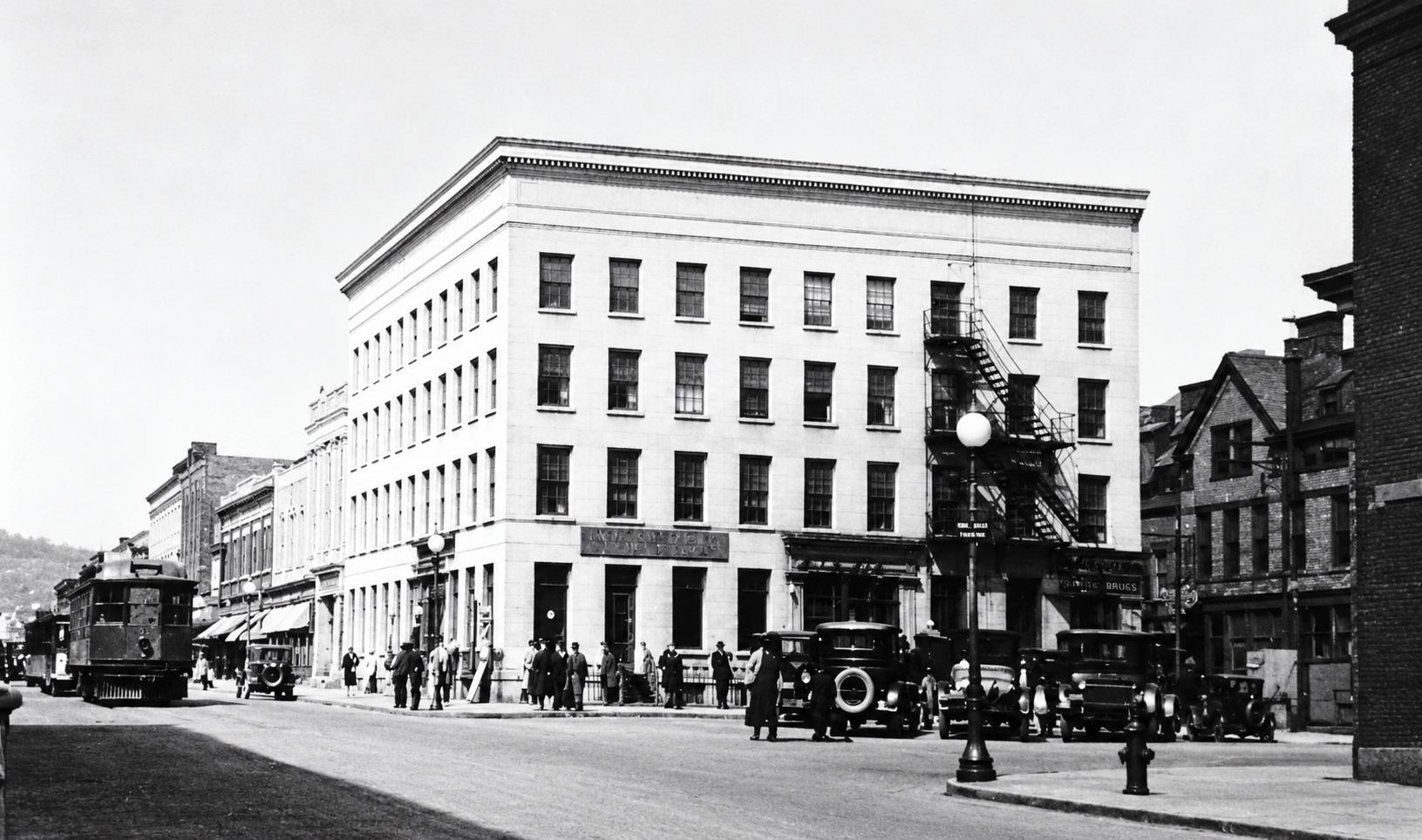
Photo from he library’s local history archive & straightened by AI
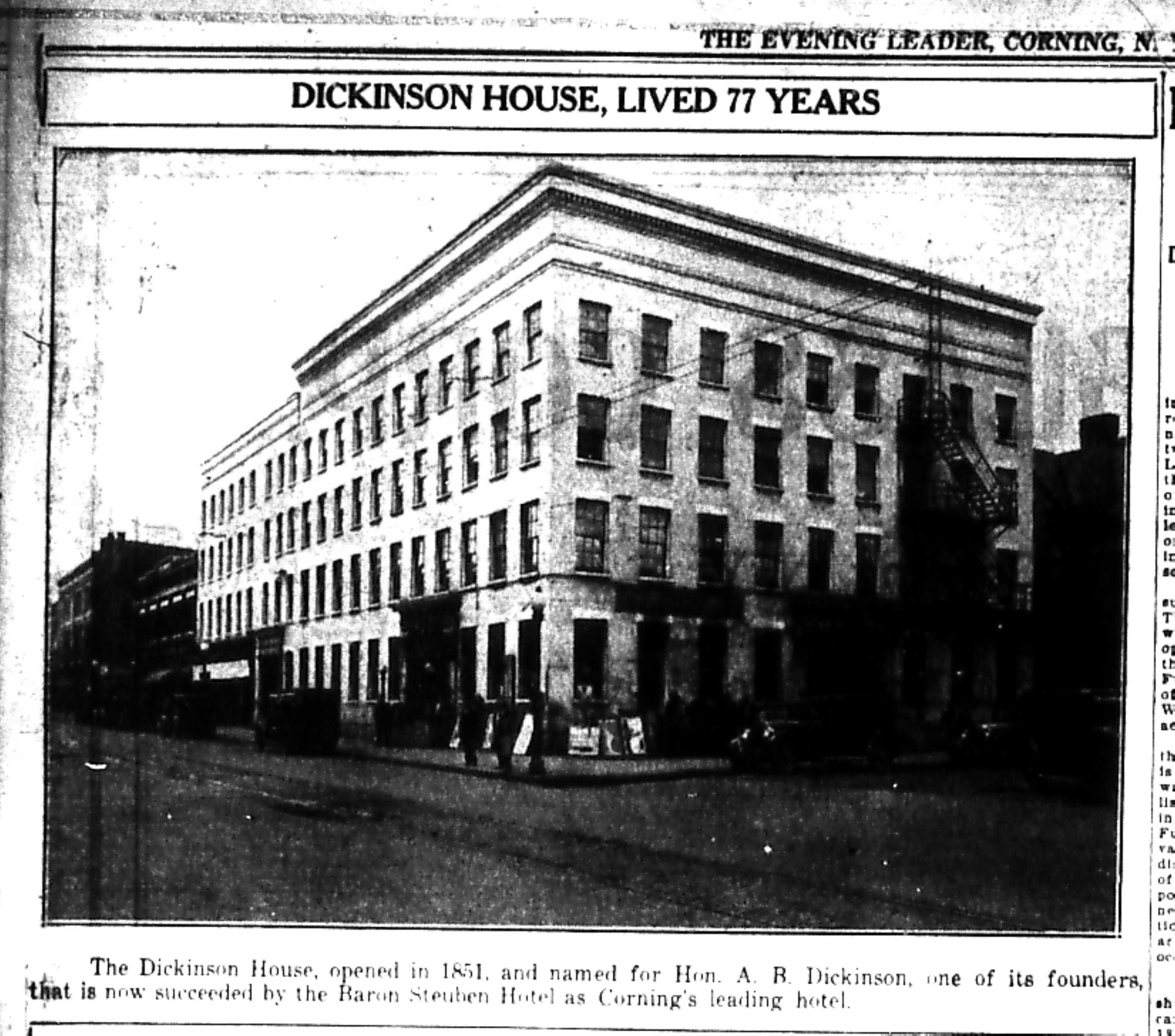
A photo of The Dickinson House from the Evening Leader (1927)
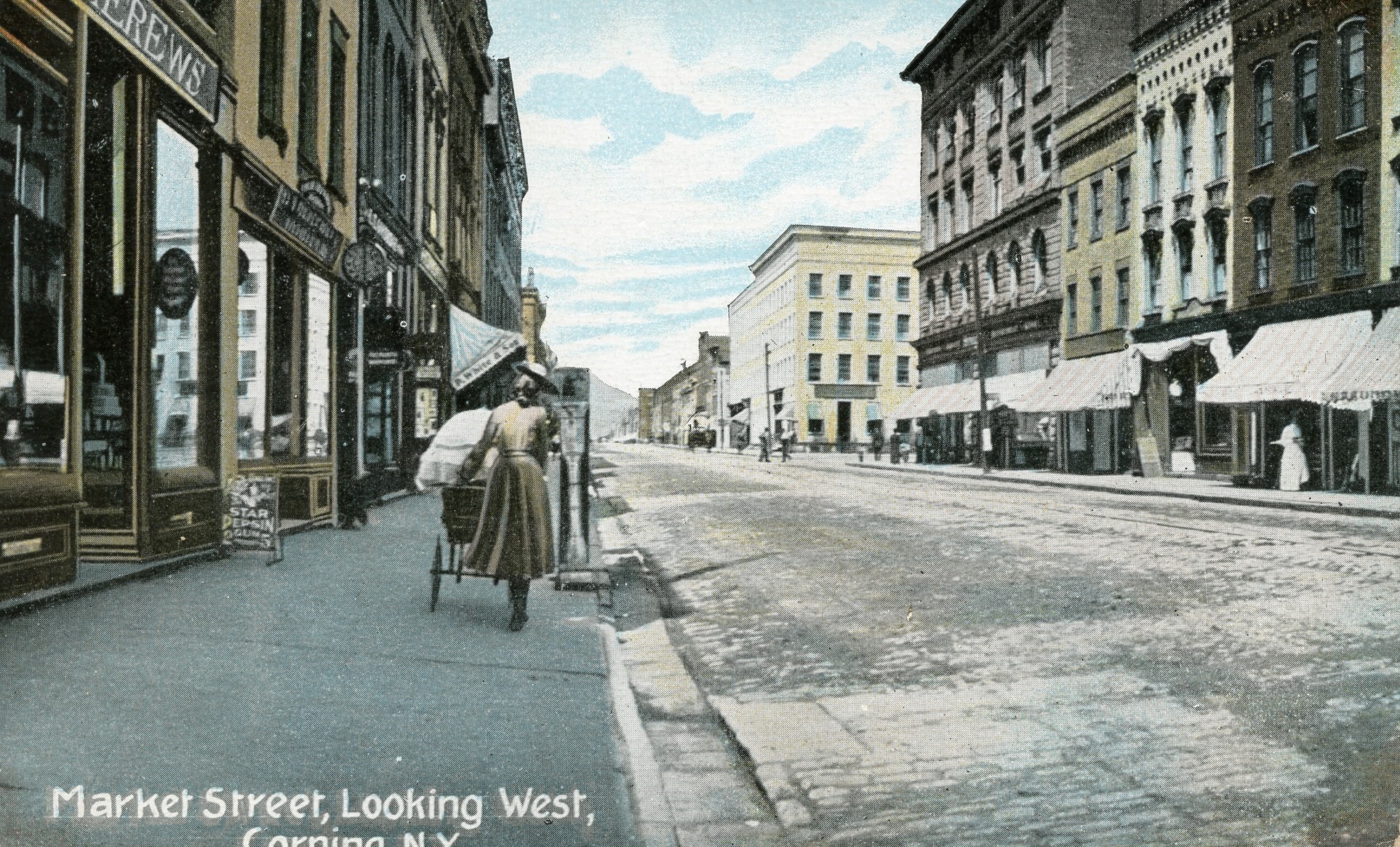
A postcard showing Market Street with the Dickinson House seen in the distance on the right, postcard from the library’s local history collection
A section of the 1888 Sanborn Map of Corning showing the location of the Erie Station & The Dickinson house
The Dickinson House – on the opening of the hotel, from the Corning Journal, September 3, 1851
Andrew B. Dickinson, For Whom Earlier Hotel Was Named Was Pioneer, The Evening Leader, Corning, N.Y. (9.10.1928)
Note: Date of dedication ceremony is in this article
Dickinson House, Lived 77 Years & Fuller Bros. for 44 Years Conducted Dickinson House
References
1851.09.03 The Dickinson House, The Corning Journal, Corning, New York.
1928.09.10 Dickinson House, Lived 77 Years. The Evening Leader, Corning, N.Y.
1928.09.10 Fuller Bros. for 44 Years Conducted Dickinson House. The Evening Leader, Corning, N.Y.
The Chemung Feeder Canal map, http://thechemungcanal.com/maps.html
Dickinson House, Corning Hotel, Closes Its Doors Monday, Giving Way to Commodious New Building. Elmira Star-Gazette. May 6, 1927.
Fallbrook Railway Map http://fallbrookrailway.com/system_maps.html
History of the Corning Painted Post Area: 200 Years in Painted Post Country by Thomas Dimitroff & Lois Jaynes (Revised edition, published by Bookmarks in 1990)
Sanborn Insurance Map of Corning, New York 1888.