Hi everyone, and welcome to our weekly local history post!
Each week we share vintage newspaper articles from years past, drawn from local publications such as the Corning Blossburg Advocate, Corning Independent, The Corning Journal, The Evening Leader, and other local newspapers. We also feature the complete issue of The Corning Leader published exactly 100 years ago. From time to time, we’ll also include newly taken photographs of local historic places, landmarks, and artifacts.
–
Vintage Article of the Week
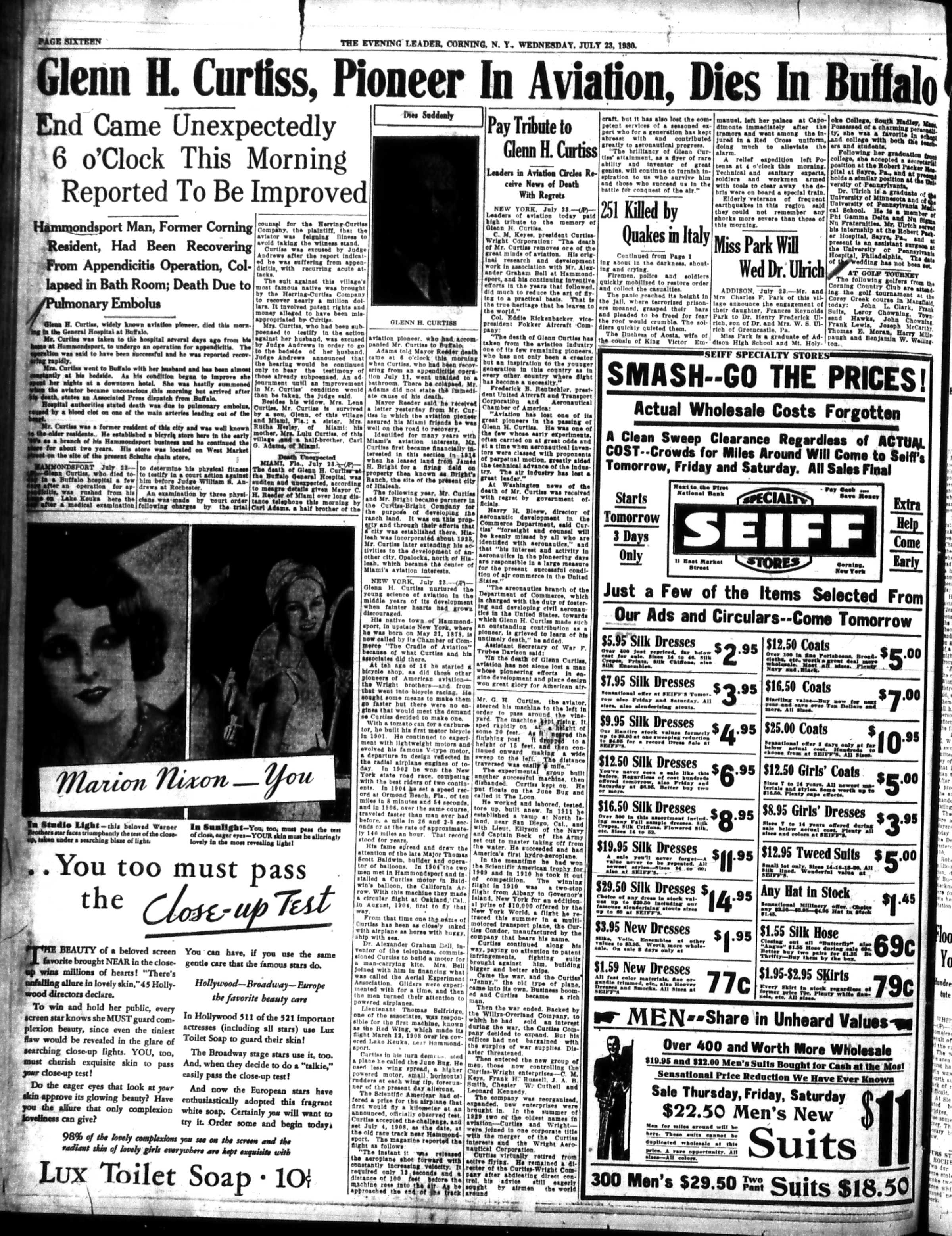
This week’s Vintage Article features the obituary of Glenn Curtiss, one of the pillars of modern aviation, who died in 1930 at age just 52, following surgery for appendicitis. As most of you out there know, and I’ll include this info for anyone who may not know – Mr. Curtiss was born in Hammondsport on May 21, 1878. And he is buried in Hammonsport too – at the Pleasant Valley Cemetery; here is a link to his page on the Find A Grave site, in case anyone would like visit is gravesite:
Heritage Quest: Heritage Quest is the library’s online genealogy service, and it includes access to census records and other research sources; it can be accessed by going to the Online Resources page, on the library’s website, and scrolling down until you see the link for Heritage Quest:
Once you’ve clicked on the Heritage Quest link, you’ll be prompted to login with your card number and PIN. If you have questions about how to use Heritage Quest, please feel free to let me know – my email address is reimerl@stls.org
–
Library Local History/Creation Station Resources: At the library you can scan your photos and slides to create digital family albums and slideshows; and even use one of the Circut machines, and other Creation Station equipment, to help you create a special paper family history album.
Also of note, we have local papers including the Corning Leader, Corning Evening Leader, Corning Journal and Corning Daily Journal, on microfilm from 1840 to the present — so you can visit the library and research local history and your family tree if you wish!
–
Local History & Newspaper blog posts are published on Fridays.
Hi everyone, and welcome to our weekly local history post!
Each week we share vintage newspaper articles from years past, drawn from local publications such as the Corning Blossburg Advocate, Corning Independent, The Corning Journal, The Evening Leader, and other local newspapers. We also feature the complete issue of The Corning Leader published exactly 100 years ago. From time to time, we’ll also include newly taken photographs of local historic places, landmarks, and artifacts.
–
Vintage Article(s) of the Week
This week our stand alone articles are all about Corning’s World War I Flying Ace – Reginald Sinclaire!
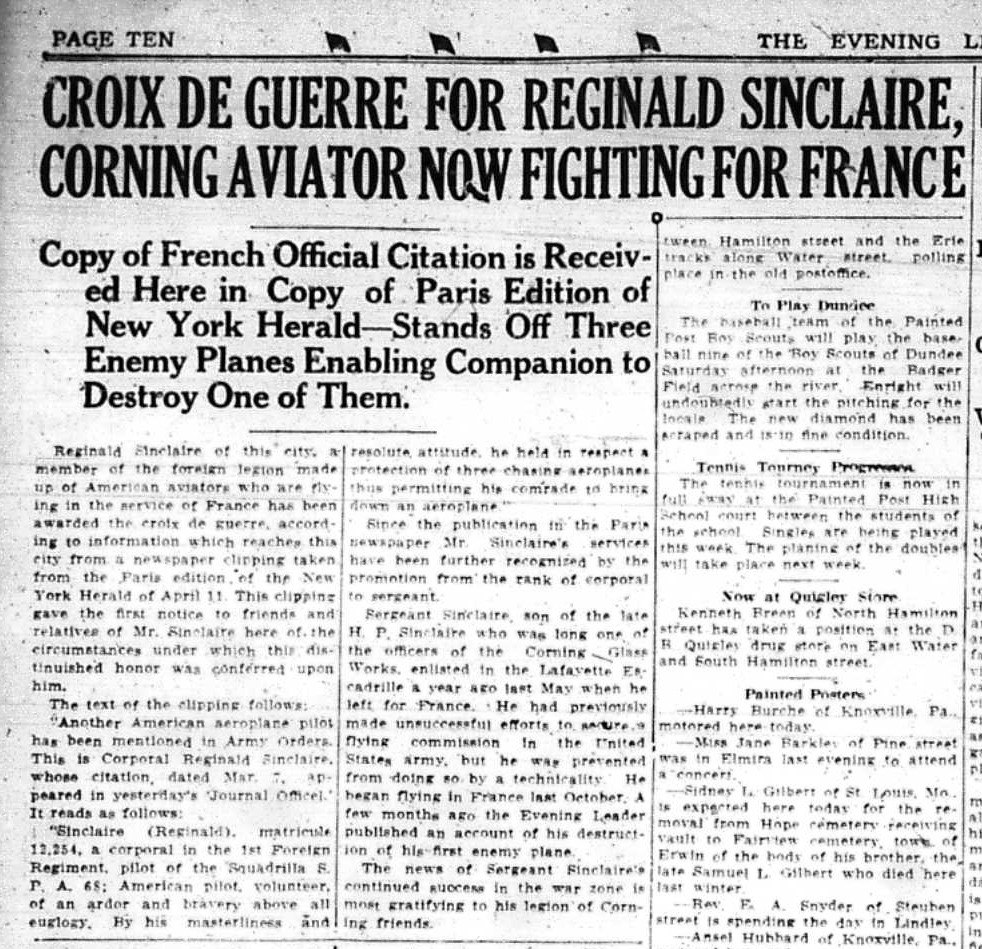
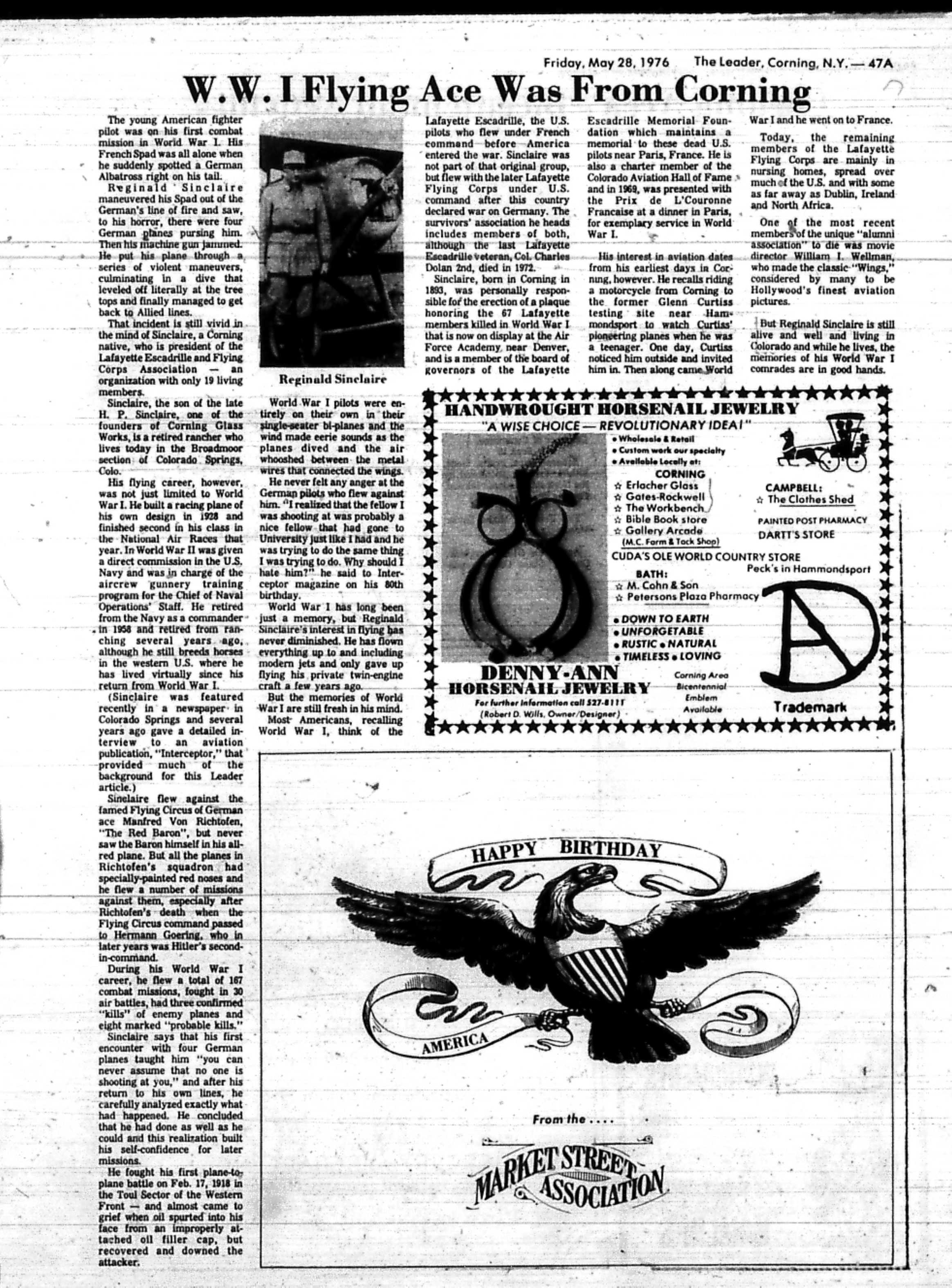
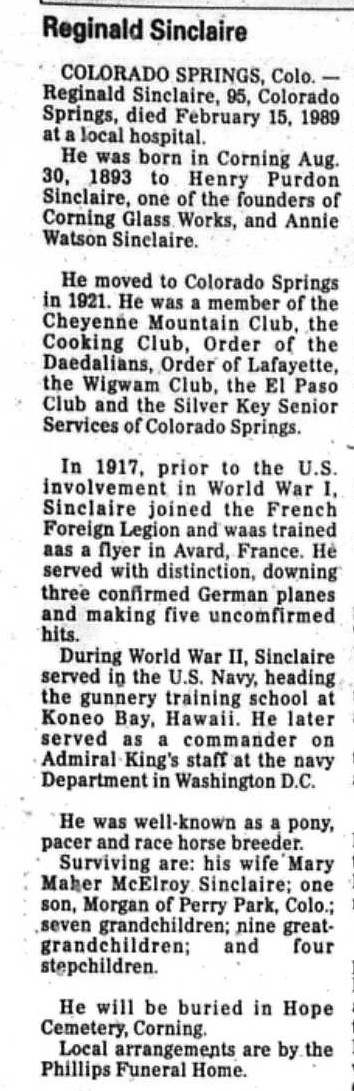
Briefly, Reginald Sinclaire was born in Corning, was interested in flight from an early age and joined the French Foreign Legion becoming a fighter pilot in France before the United States entered World War I. For his outstanding service, he was awarded the French Croix de Guerre citation by the French government in 1918 – which is what the following article reports. The two related items include a piece from the Leader (1976) giving an overview of his World War I career, and his obituary from the Leader; he died in 1989, and had lived in Colorado Springs, Colorado for decades – but was buried here, in Hope Cemetery.
Croix de Guerre For Reginald Sinclaire, Corning Aviator Now Fighting For France from the Evening Leader, June 6, 1918
And as the above article is a bit hard to read – here is the text of it:
The Evening Leader, Corning, New York, June 6, 1918, p.10
Croix De Guerre For Reginald Sinclaire, Corning Aviator Now Fighting For France
Copy of French Citation is Received Here in Copy of Paris Edition of New York Herald–Stands Off Three Enemy Planes Enabling Companion To Destroy One of Them.
Reginald Sinclaire of this city a member of the foreign legion made up of American Aviators who are flying in the service of France has been awarded the Croix de guerre, according to information which reaches this city from a newspaper clipping taken from the Paris edition of the New York Herald of April 11. This clipping gave the first notice to friends and relatives of Mr. Sinclaire here of the circumstances under which this distinguished honor was conferred upon him.
The text of the clipping follows:
“Another American aeroplane pilot has been mentioned in Army Orders. This is Corporal Reginald Sinclaire, whose citation, dated Mar. 7, appeared in yesterday’s’ Journal Officel.”
“Sinclaire (Reginald), matricula 13,254, a corporal in the 1st Foreign Regiment, pilot of the Squadrilla S P. A. 68; American pilot, volunteer, of an ardor and bravery above all eulogy. By his masterliness and resolute attitude, he held in respect a protection of three chasing aeroplanes, thus permitting his comrade to bring down an aeroplane.”
Since the publication in the Paris newspaper Mr. Sinclaire’s services have been further recognized by the promotion from the rank of corporal to sergeant.
Sergeant Sinclaire, son of the late H. P. Sinclaire who was long one of the officers of the Corning Glass Works, enlisted in the Lafayette Escadrille a year ago last May when he left for France. He had previously made unsuccessful efforts to secure a flying commission in the United States army but was prevented from doing so by a technicality. He began flying in France last October. A few months ago the Evening Leader published an account of his destruction of his first enemy plane.
The news of Sergeant Sinclaire’s continued success in the war zone is most gratifying to his legion of Corning friends.
–
W. W. I Flying Ace Was From Corning | May 28, 1976, The Leader, Corning, N.Y.
–
And for a bit more information on his life, here is Reginald Sinclaire‘s obituary from the Corning Leader, February 22, 1989
A Glimpse of Local Life: A Hundred Years Ago!
Here is an entire issue of The Evening Leader, Corning, N.Y. published on this day in 1926.
–
The Evening Leader, Corning, N.Y. | October 16, 2026
Heritage Quest: Heritage Quest is the library’s online genealogy service, and it includes access to census records and other research sources; it can be accessed by going to the Online Resources page, on the library’s website, and scrolling down until you see the link for Heritage Quest:
Once you’ve clicked on the Heritage Quest link, you’ll be prompted to login with your card number and PIN. If you have questions about how to use Heritage Quest, please feel free to let me know – my email address is reimerl@stls.org
–
Library Local History/Creation Station Resources: At the library you can scan your photos and slides to create digital family albums and slideshows; and even use one of the Circut machines, and other Creation Station equipment, to help you create a special paper family history album.
Also of note, we have local papers including the Corning Leader, Corning Evening Leader, Corning Journal and Corning Daily Journal, on microfilm from 1840 to the present — so you can visit the library and research local history and your family tree if you wish!
–
Local History & Newspaper blog posts are published on Fridays.
Hi everyone, and welcome to our weekly local history post!
Each week we share vintage newspaper articles from years past, drawn from local publications such as the Corning Blossburg Advocate, Corning Independent, The Corning Journal, The Evening Leader, and other local newspapers. We also feature the complete issue of The Corning Leader published exactly 100 years ago. From time to time, we’ll also include newly taken photographs of local historic places, landmarks, and artifacts.
–
Vintage Article of the Week
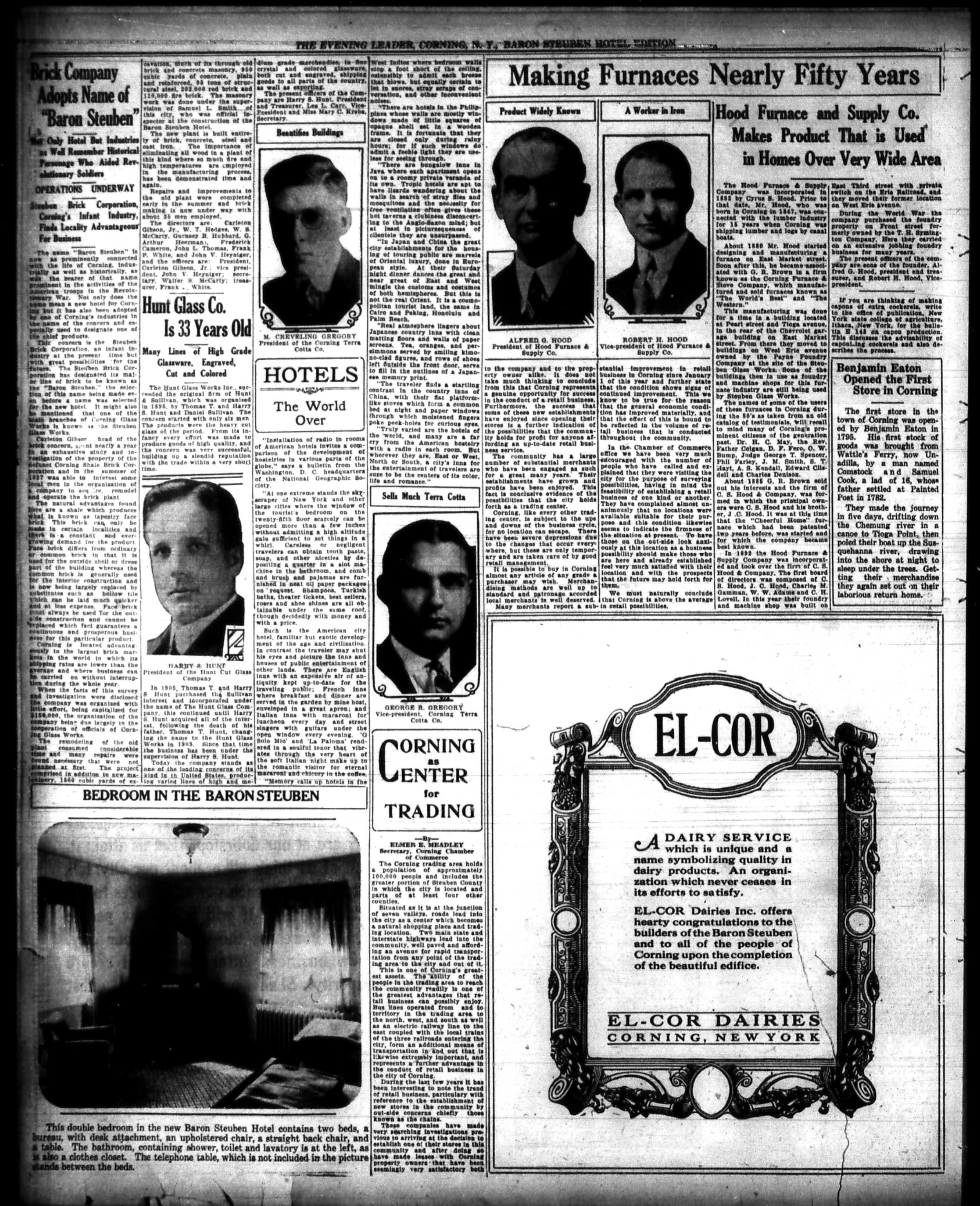
This page is from the Baron Steuben Edition of The Evening Leader, dated September 10, 1928; and hit features a neat short story, on the right hand side of the page about the first store to be opened in Corning, titled Benjamin Eaton Opened First Store in Corning – in 1795!; and I was just going to crop that article but found this entire page interesting – especially the articles on the Brick Company, Hunt Glass and the Hood Furnace Company – and, well, I figured local history fans would appreciate all those other stories too – thus I’m including the entire page.
–
A Glimpse of Local Life: A Hundred Years Ago!
Here is an entire issue of The Evening Leader, Corning, N.Y. published on this day in 1926.
–
The Evening Leader, Corning, N.Y. | October 9, 1926
P.S. As an FYI, if you haven’t heard, they’ve announced the inductees into the Steuben County Hall of Fame, class of 2026: Dr. James D. Folts, Jr., Joseph J. Haruyski, Joseph “Bud” Meade III, Joseph John Nasser, Ellen J. Sherwood McDowell Oliver, Frank C. Platt, Dr. Karol Wight, Dr. Paul Wolfgruber; and the following link featuring more information, including a bio of each person: https://wlea.net/2026-steuben-county-hall-of-fame-inductees/?amp=1
Have a great weekend everyone,
Linda Reimer, SSCL
–
Local History Online Library Resources:
Heritage Quest: Heritage Quest is the library’s online genealogy service, and it includes access to census records and other research sources; it can be accessed by going to the Online Resources page, on the library’s website, and scrolling down until you see the link for Heritage Quest:
Once you’ve clicked on the Heritage Quest link, you’ll be prompted to login with your card number and PIN. If you have questions about how to use Heritage Quest, please feel free to let me know – my email address is reimerl@stls.org
–
Library Local History/Creation Station Resources: At the library you can scan your photos and slides to create digital family albums and slideshows; and even use one of the Circut machines, and other Creation Station equipment, to help you create a special paper family history album.
Also of note, we have local papers including the Corning Leader, Corning Evening Leader, Corning Journal and Corning Daily Journal, on microfilm from 1840 to the present — so you can visit the library and research local history and your family tree if you wish!
–
Local History & Newspaper blog posts are published on Fridays.
Hi everyone, and welcome to our weekly local history post!
Each week we share vintage newspaper articles from years past, drawn from local publications such as the Corning Blossburg Advocate, Corning Independent, The Corning Journal, The Evening Leader, and other local newspapers. We also feature the complete issue of The Corning Leader published exactly 100 years to the day. From time to time, we’ll also include newly taken photographs of local historic places, landmarks, and artifacts.
–
Vintage Article of the Week
This week our vintage article this week is an obituary which offers us a look at the life of the famous Corning-based cut glass icon Thomas Hawkes (1846 – 1913), who incidentally is a member of the Steuben County Hall of Fame.
Briefly, Thomas Hawkes was born in Ireland in 1846, moved to New York City as a youth, had a fortuitous encounter with John Hoare (1823 – 1896) co-owner of the Hoare & Dailey cut glass company; Hawkes was then hired by Hoare who moved his cut glass company to Corning in 1868 at the request of Amory Houghton Sr. (1812 – 1882) who had just moved his company the Brooklyn Flint Glass Works, later rechristened the Corning Glass Works, to Corning. Hawkes moved to Corning with the Hoare Company, worked there as a draughtsman and first, learned everything he could about the glass cutting business; and later with hard work and determination to be the best cut glass manufacturer he could be; he opened his own glass cutting business which gained renowned around the world for the quality of its glass.
His obituary is rather long – the digital copy, which I found on the Corning Leader microfilm, is fuzzy at best – so I thought I’d be helpful and type out what it says – and the obit turns out to be 3,052 words long! The obituary, really is a great mini-bio of Hawkes offering a fascinating glimpse into his life with a solid look at his lineage too – check it out!
Here is the actual obituary:
Thomas Gibbons Hawkes Founder of Some of Corning’s Leading Enterprises Died Last Night
From the Evening Leader, Corning, N.Y., July 8, 1913
Heritage Quest: Heritage Quest is the library’s online genealogy service, and it includes access to census records and other research sources; it can be accessed by going to the Online Resources page, on the library’s website, and scrolling down until you see the link for Heritage Quest:
Once you’ve clicked on the Heritage Quest link, you’ll be prompted to login with your card number and PIN. If you have questions about how to use Heritage Quest, please feel free to let me know – my email address is reimerl@stls.org
–
Library Local History/Creation Station Resources: At the library you can scan your photos and slides to create digital family albums and slideshows; and even use one of the Circut machines, and other Creation Station equipment, to help you create a special paper family history album.
Also of note, we have local papers including the Corning Leader, Corning Evening Leader, Corning Journal and Corning Daily Journal, on microfilm from 1840 to the present — so you can visit the library and research local history and your family tree if you wish!
–
Local History & Newspaper blog posts are published on Fridays.
Hi everyone, and welcome to our weekly local history post!
Each week we share vintage newspaper articles from years past, drawn from local publications such as the Corning Blossburg Advocate, Corning Independent,The Corning Journal, The Evening Leader, and other local newspapers. We also feature the complete issue of The Corning Leader published exactly 100 years to the day from each blog post. From time to time, we’ll also include newly taken photographs of local historic places, landmarks, and artifacts.
–
Vintage Article/Items of the Week
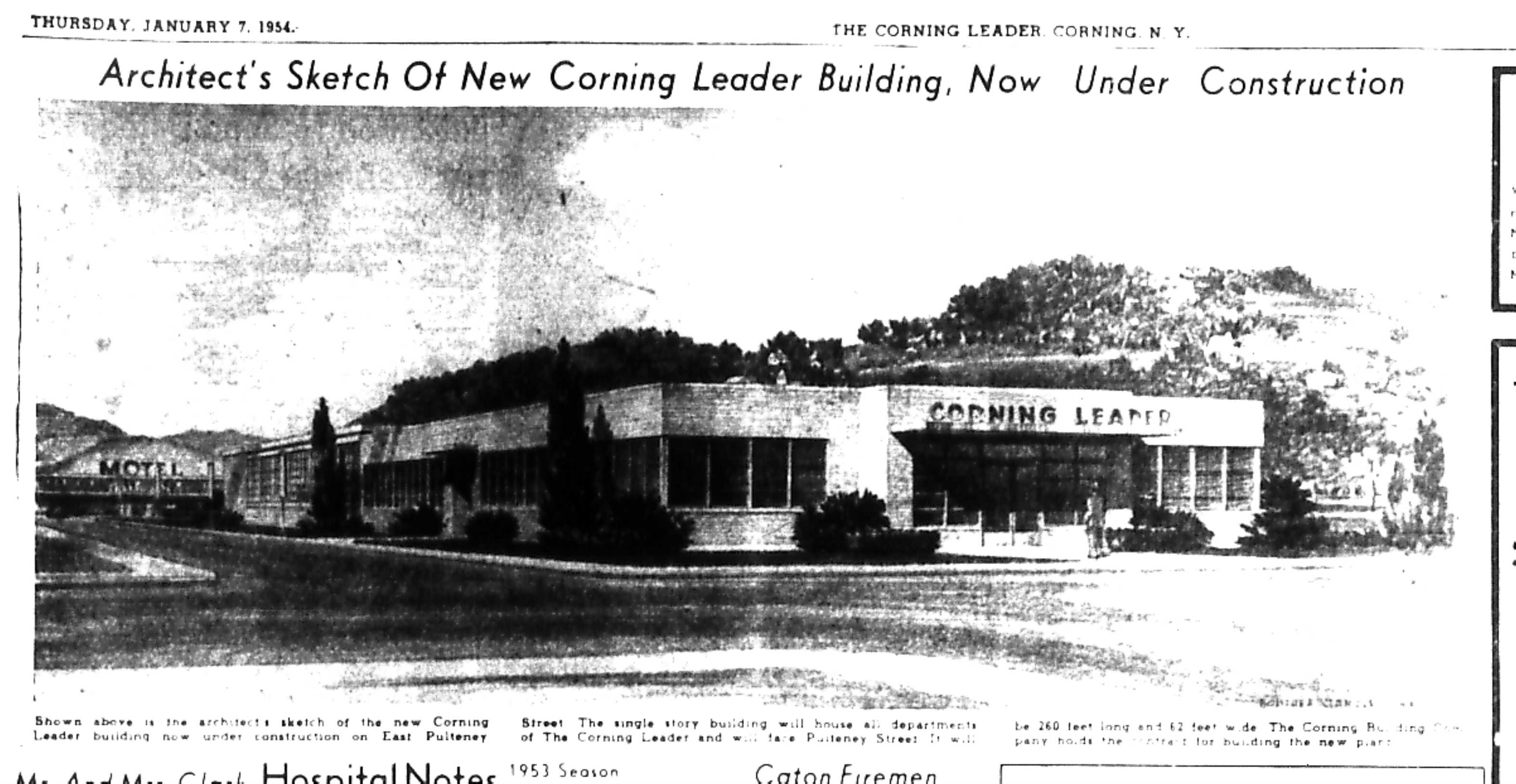
Here is a sketch of the then to be built Corning Leader building; which was once located on East Pulteney Street in Corning
(from The Corning Leader, January 7, 1954)
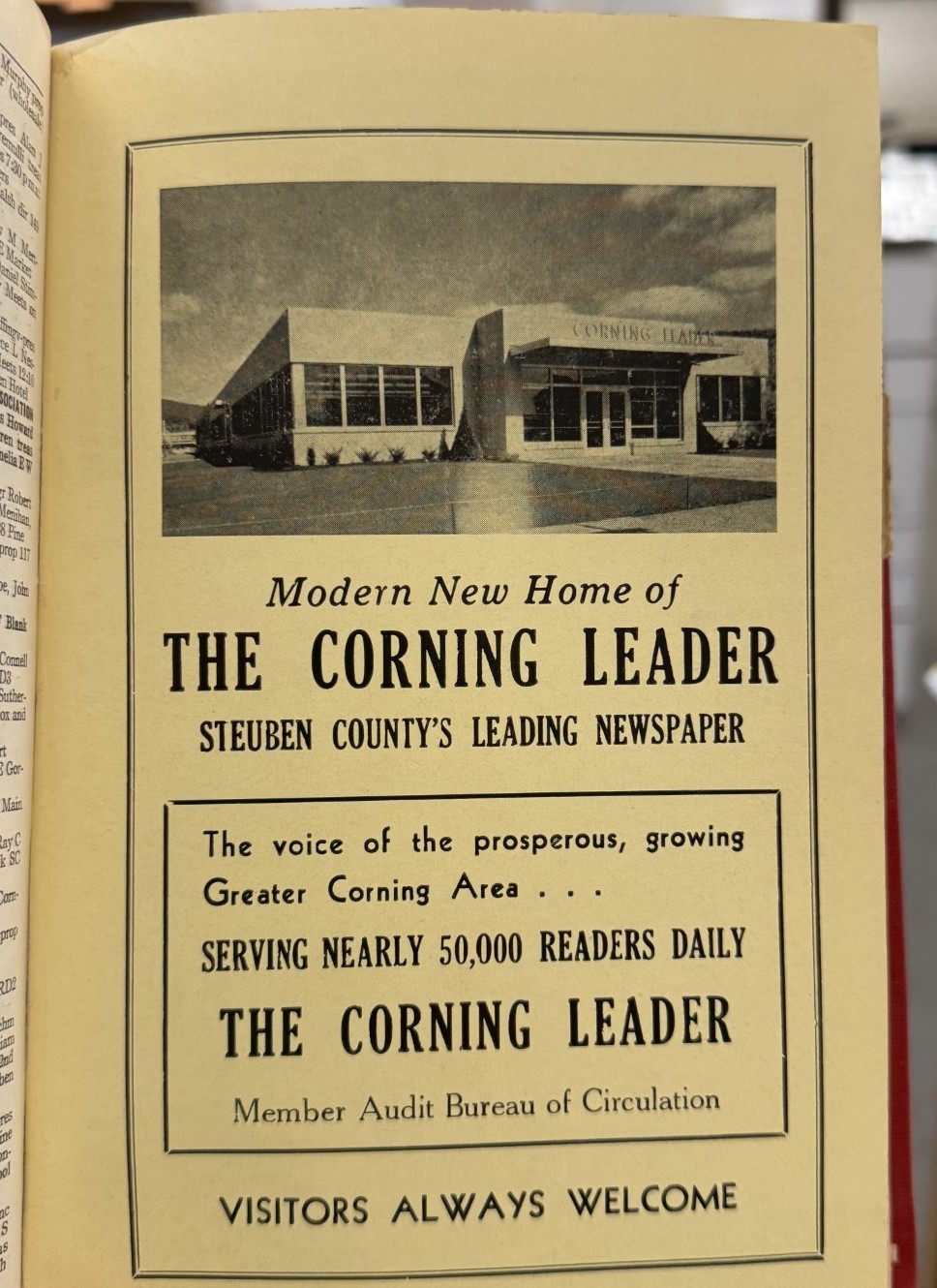
And here is a photo of what the building looked like, once built – from the 1955 City of Corning directory
–
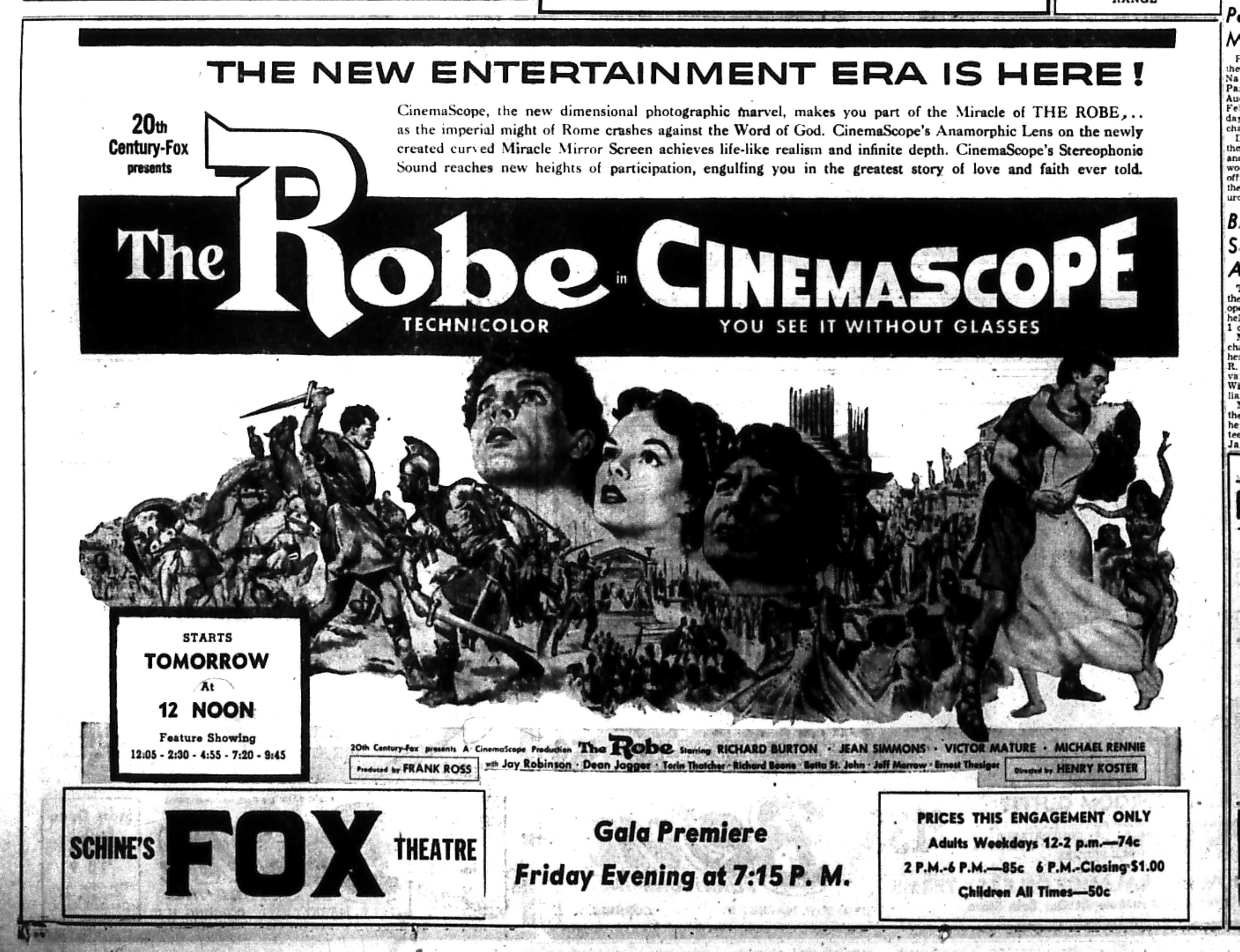
And on another note, once upon a time, in the era before everyone had a TV; and years before the internet – going to the movies was a big deal. And so when the old Fox Theatre, which was once located on Denison Parkway in Corning, between the Githler Tanner Building and Goodyear Auto, upgraded their equipment to show movies in the new CinemaScope format; and premiered the first film ever released in that format – The Robe, on January 15, 1954, it was a big deal!
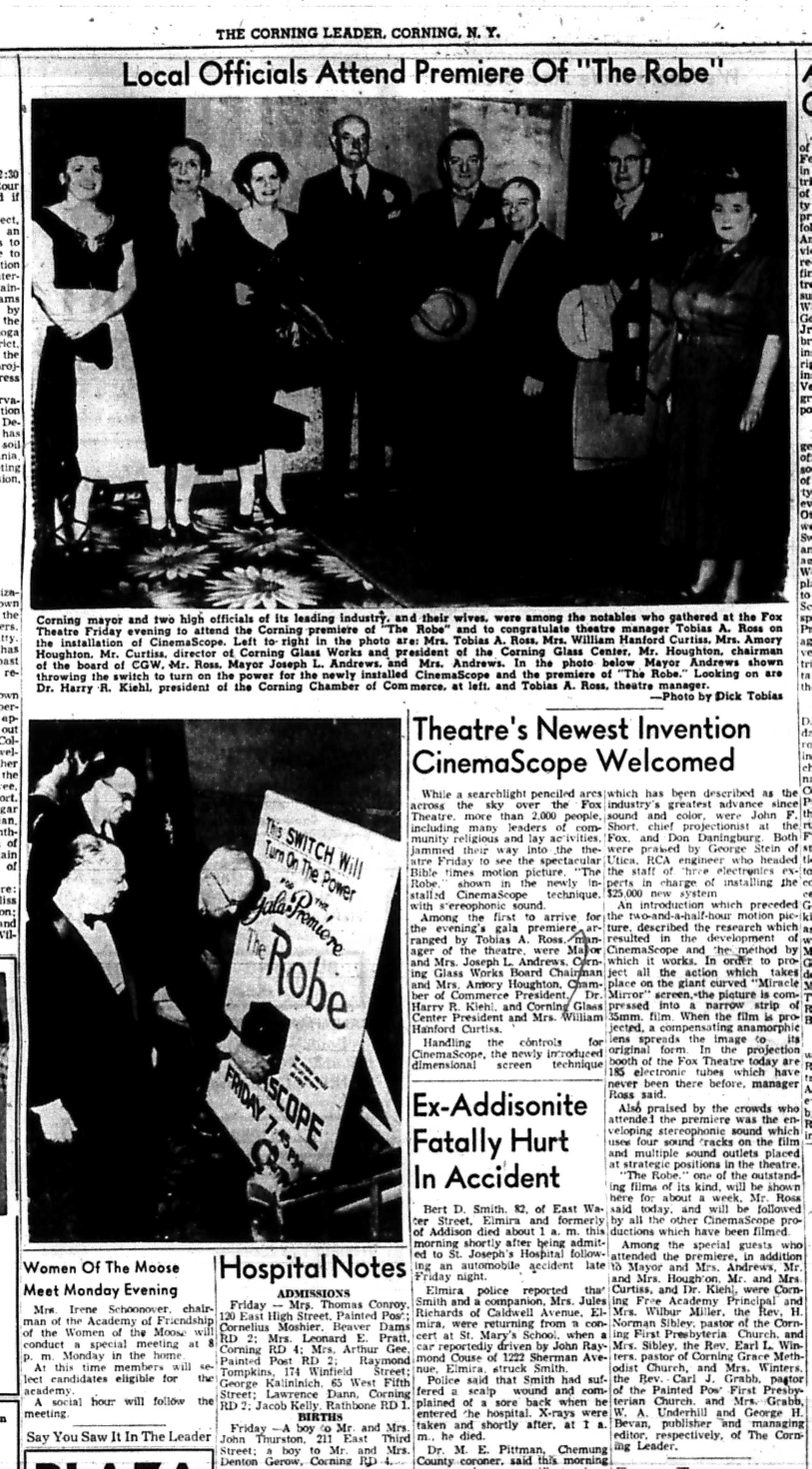
Premier attendees included Mayor Joseph Andrews & C. G. W. President Amory Houghton Sr. and their wives; and Mayor Andrews flipped the switch to turn on CinemaScope!
An ad for the upcoming premier, published the Thursday before, shows that the ticket prices were $1.00 for evening showings, $0.74 for matinee showings and $0.50 for kids at any showing.
So our first item is the ad, followed by the article from the Leader, from January 16, 1954 that spotlights the the film premier at the Fox Theatre:
The Robe Advertisement
(from The Corning Leader, Corning, N.Y., January 16, 1954)
Local Officials Attend Premiere Of “The Robe” & Theatre’s Newest Invention CinemaScope Welcomed
(from The Corning Leader, Corning, N.Y., January 16, 1954)
In case you’ve never seen it, The Robe, is a biblical epic that features great performances – Burton was nominated for an Oscar for his portrayal of the lead character Marcellus Gallio, a Roman tribune who is assigned to oversee the crucifixion of three thieves, one of whom turns out to be Jesus Christ. And Jean Simmons has the role of his love Diana.
To movie does not seem to be available to stream, but the DVD can be checked out of the library, if you’d like to check it out and/or check out how it looks in CinemaScope – here is the trailer:
–
And now, back to local history!
A Glimpse of Local Life: A Hundred Years Ago!
Here is an entire issue of The Evening Leader, Corning, N.Y. published on this day in 1926.
–
The Evening Leader, Corning, N.Y. |September 25, 1926
Heritage Quest: Heritage Quest is the library’s online genealogy service, and it includes access to census records and other research sources; it can be accessed by going to the Online Resources page, on the library’s website, and scrolling down until you see the link for Heritage Quest:
Once you’ve clicked on the Heritage Quest link, you’ll be prompted to login with your card number and PIN. If you have questions about how to use Heritage Quest, please feel free to let me know – my email address is reimerl@stls.org
–
Library Local History/Creation Station Resources: At the library you can scan your photos and slides to create digital family albums and slideshows; and even use one of the Circut machines, and other Creation Station equipment, to help you create a special paper family history album.
Also of note, we have local papers including the Corning Leader, Corning Evening Leader, Corning Journal and Corning Daily Journal, on microfilm from 1840 to the present — so you can visit the library and research local history and your family tree if you wish!
–
Local History & Newspaper blog posts are published on Fridays.
Hi everyone, I was going to turn the spotlight of this local history post on Corning’s grand old hotel, The Dickinson House; and I will talk about that in a moment – first though, I want to note the passing of educator and historian Thomas Dimitroff who died yesterday.
As you probably know Thomas Dimitroff taught history locally for decades; indeed he was teaching at the middle school version of C.F.A. when I was there; he wrote books on the Houghton Family, Frederick Carder and Steuben Glass and more; including a book he co-authored with fellow C.F.A. teacher and historian Lois Janes, which is the book I recommend to anyone/everyone stopping by the library and looking to learn about the history of our region – History of the Corning-Painted Post Area: 200 Years in Painted Post Country.
Sadly, Mr. Dimitroff died yesterday, and it was announced through the Carder Steuben Glass Association, of which he was a founding member, this morning, here is the link:
In his honor I suggested taking a look at one of his books – if you don’t already have one – stop by the library and check them out –
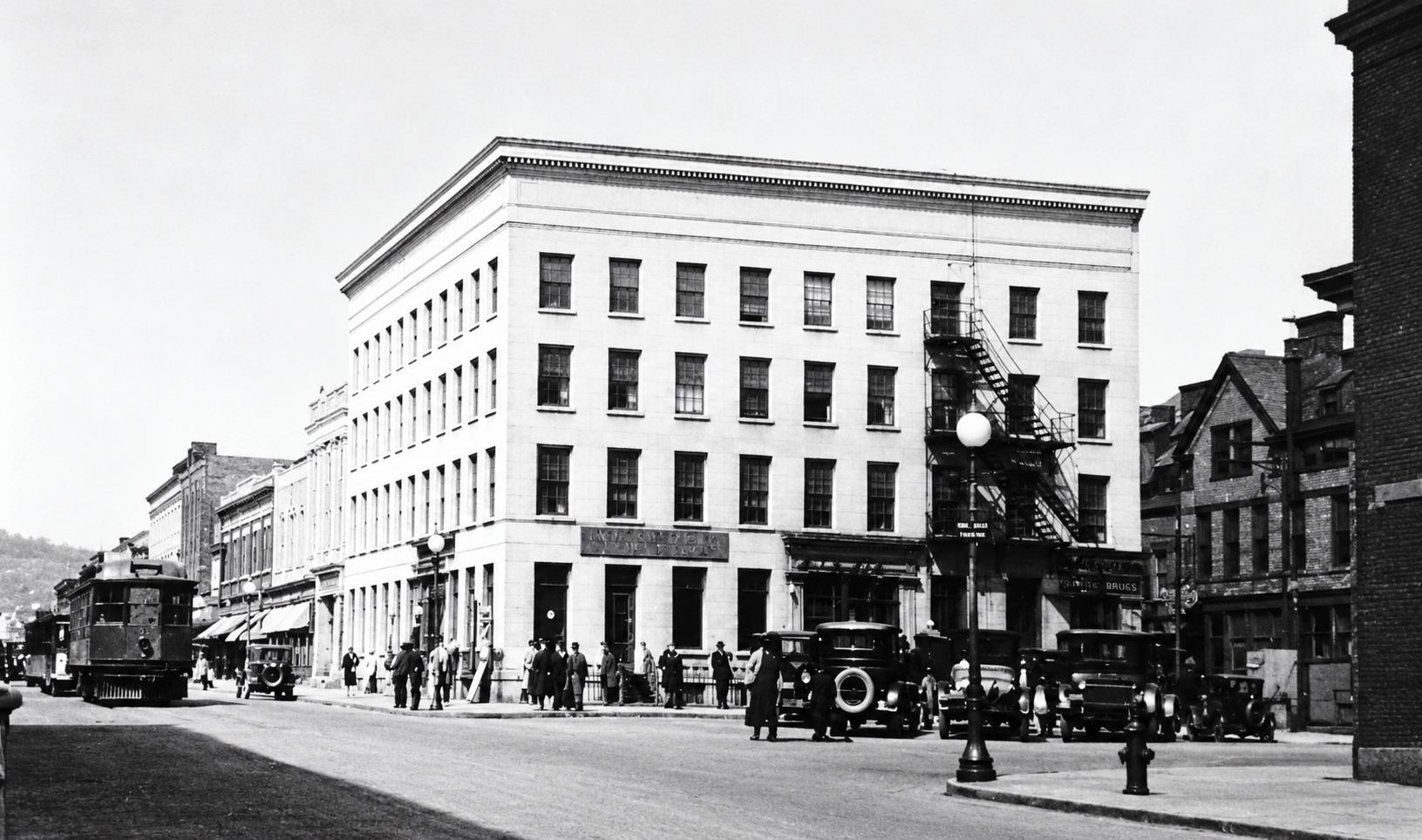
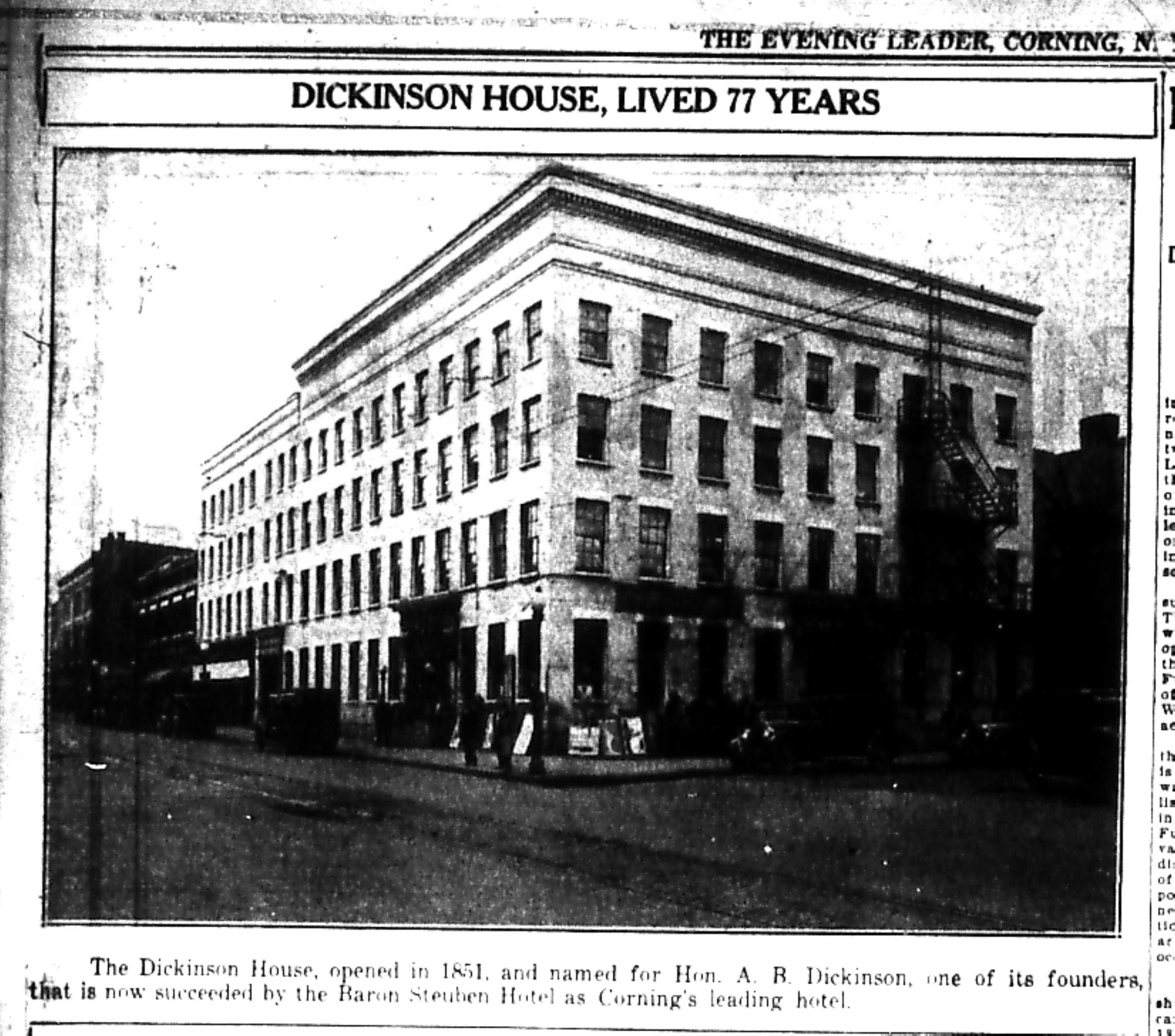
And getting back to the Dickinson House, it was a large, grand hotel which was very fancy for the small village of Corning, New York, when it first opened. It was located on what was then Pine Street Square and is today Centerway Square; it was built by Andrew Bray Dickinson and Hiram Bostwick and officially opened with a dedication ceremony on September 24, 1851; one hundred and seventy-five years ago today!
Andrew Bray Dickinson is himself a notable local, in addition to helping to finance and build the Dickinson House, he was a state senator, the first Town Supervisor of Hornby, N.Y. and U.S. Ambassador to Nicaragua. He is also a member of the Steuben County Hall of Fame. And he had very little to do with running the hotel named after him after it was opened – the most notable people to run the hotel were two brothers; George & Dwight Fuller who ran the hotel for 44 years – and that is another story for a later date! As really is the story of both Mr. Dickinson and his partner Hiram Bostwick – who both lived interesting lives.
Getting back to the Dickinson House, for a more in-depth history of the hotel, check out the Leader articles listed below; and for those who appreciate brevity, here is a short history:
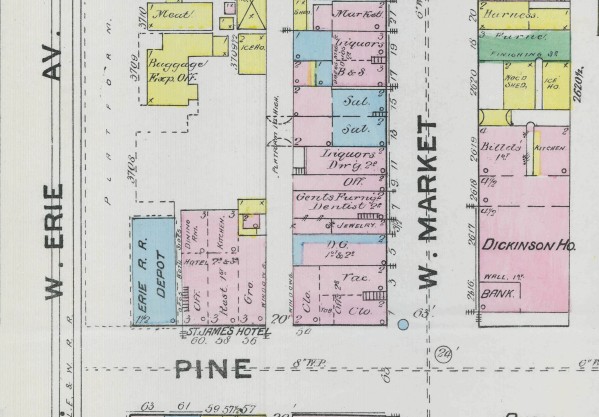
Corning had been incorporated as a village in July of 1848, and the village then had a population of approximately 3,000 (Dimitroff-Jaynes, p25). Corning was situated in a great location for travelers to stop and goods to travel through; being connected both to the Erie Canal system by the Chemung River, via the nearby Chemung Feeder Canal; and to the railroads; most notably the Blossburg, Corning & Tioga Railroad and the Erie Railroad, which had tracks right down Erie Avenue (Denison Parkway) in Corning (Dimitroff-Janes, p81-83.) In fact, the Erie Railway Station was located on the corner of Pine and Erie Avenue, just one block away from Pine Street Square. (See the close up of the 1888 Sanborn map of Corning below for more info.)
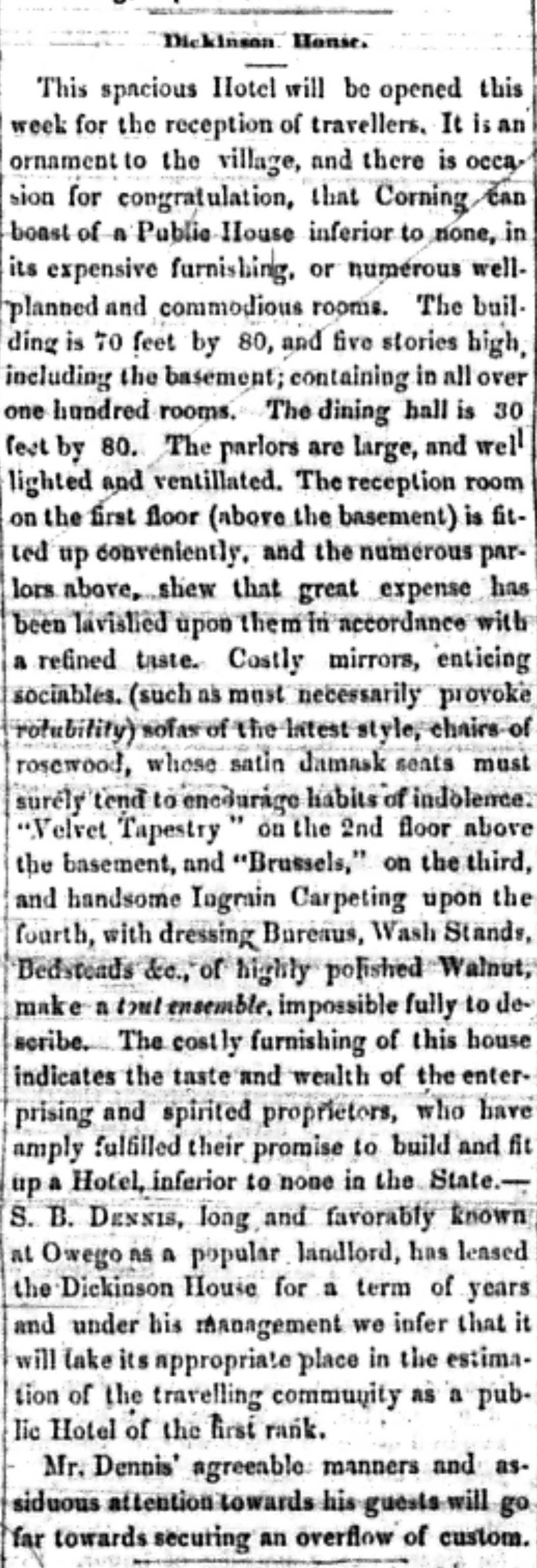
So, in 1851 Corning was a jumping transportation hub and a place for travelers to stop on their way to far off destinations. And with that in mind, Dickinson and Bostwick built their grand hotel on Pine Street Square. The hotel featured five floors, 100 spacious rooms, a huge dining hall, multiple parlors and a lobby with a tiled floor and intricate oak woodwork. The building was lavishly furnished too; and featured large mirrors, ingrain carpeting, high-end stylish sofas, rosewood chairs and velvet tapestries; it was well light and ventilated too – ventilation being a concern in the days before air conditioning technology made its debut.
The grand old Dickinson House was a mainstay in Corning for decades hosting many visitors and gatherings over the years, but time marches on as it always does; and in 1927 the Corning Hotel Corporation purchased the property, demolished the old hotel, which closed its doors in May 1927, and built a newer more modern hotel in its place – the Baron Steuben Hotel. The hotel building still stands although it is no longer a used as a hotel, but it is still in use – the Old World Café is the most visible business in the building, being located on the corner of the ground-floor adjacent to Centerway Square. (Elmira Star-Gazette, 5.6.1927)
So, the next time you walk or drive by the Baron Steuben building take a minute and remember its predecessor the grand old Dickinson House! (and think of all the history that unfolded within its walls!)
Have a great day,
Linda Reimer, SSCL
The Dickinson House: Articles & Photos
The Dickinson House(circa 1920s)
Photo from he library’s local history archive & straightened by AI
A photo of The Dickinson House from the Evening Leader (1927)
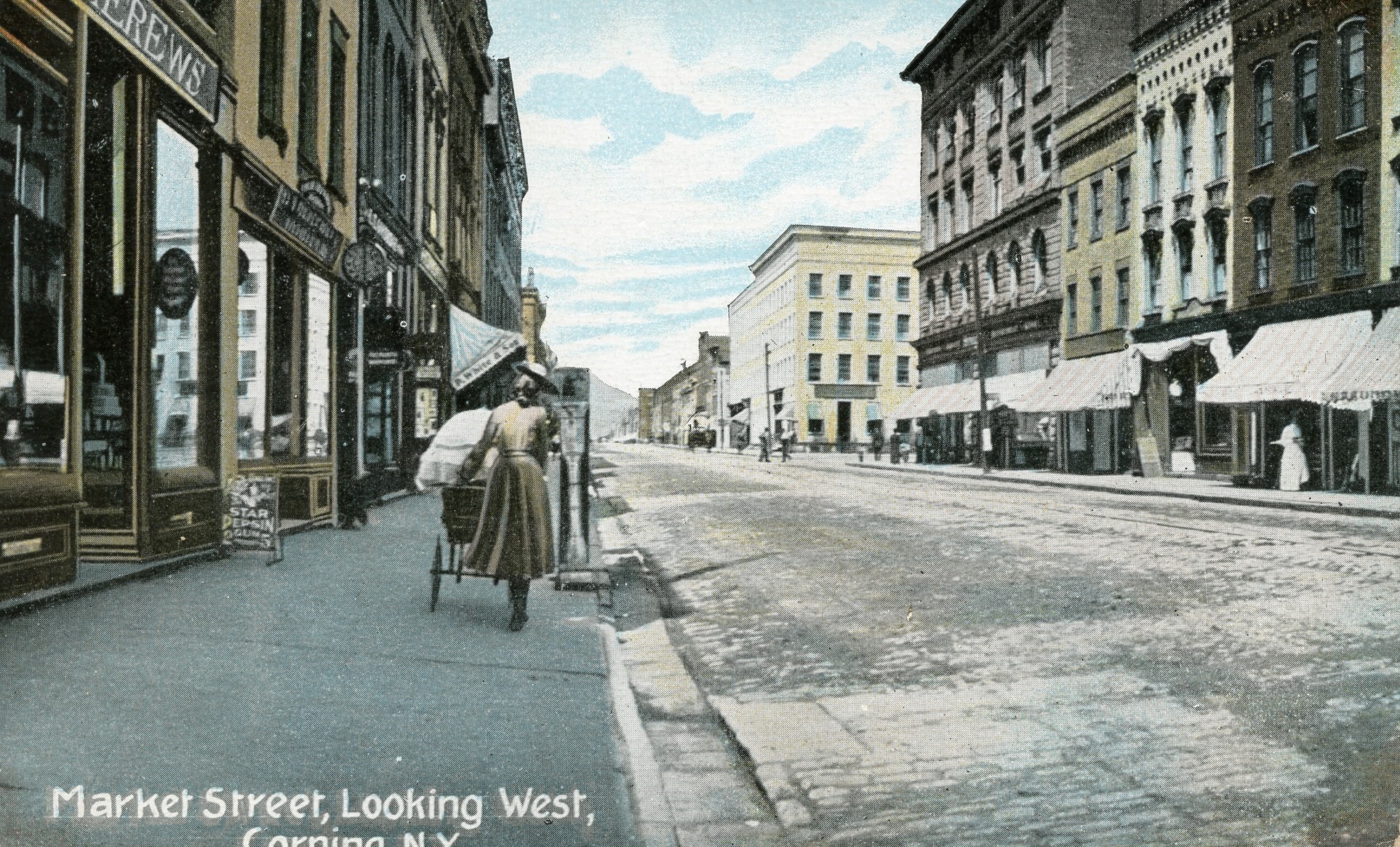
A postcard showing Market Street with the Dickinson House seen in the distance on the right, postcard from the library’s local history collection
A section of the 1888 Sanborn Map of Corning showing the location of the Erie Station & The Dickinson house
The Dickinson House – on the opening of the hotel, from the Corning Journal, September 3, 1851
Andrew B. Dickinson, For Whom Earlier Hotel Was Named Was Pioneer, The Evening Leader, Corning, N.Y. (9.10.1928)
Note: Date of dedication ceremony is in this article
History of the Corning Painted Post Area: 200 Years in Painted Post Country by Thomas Dimitroff & Lois Jaynes (Revised edition, published by Bookmarks in 1990)
Hi everyone, and welcome to our weekly local history post!
Each week we’ll share vintage newspaper articles from years past, drawn from local publications such as the Corning Blossburg Advocate, Corning Independent,The Corning Journal, The Evening Leader, and other local newspapers. We’ll also feature the complete issue of The Corning Leader exactly 100 years to the day from each blog post. From time to time, we’ll include newly taken photographs of local historic places, landmarks, and artifacts.
–
Vintage Article(s) of the Week
This week we have two vintage articles of the week; both from 1926 and a map that relates to the second article.
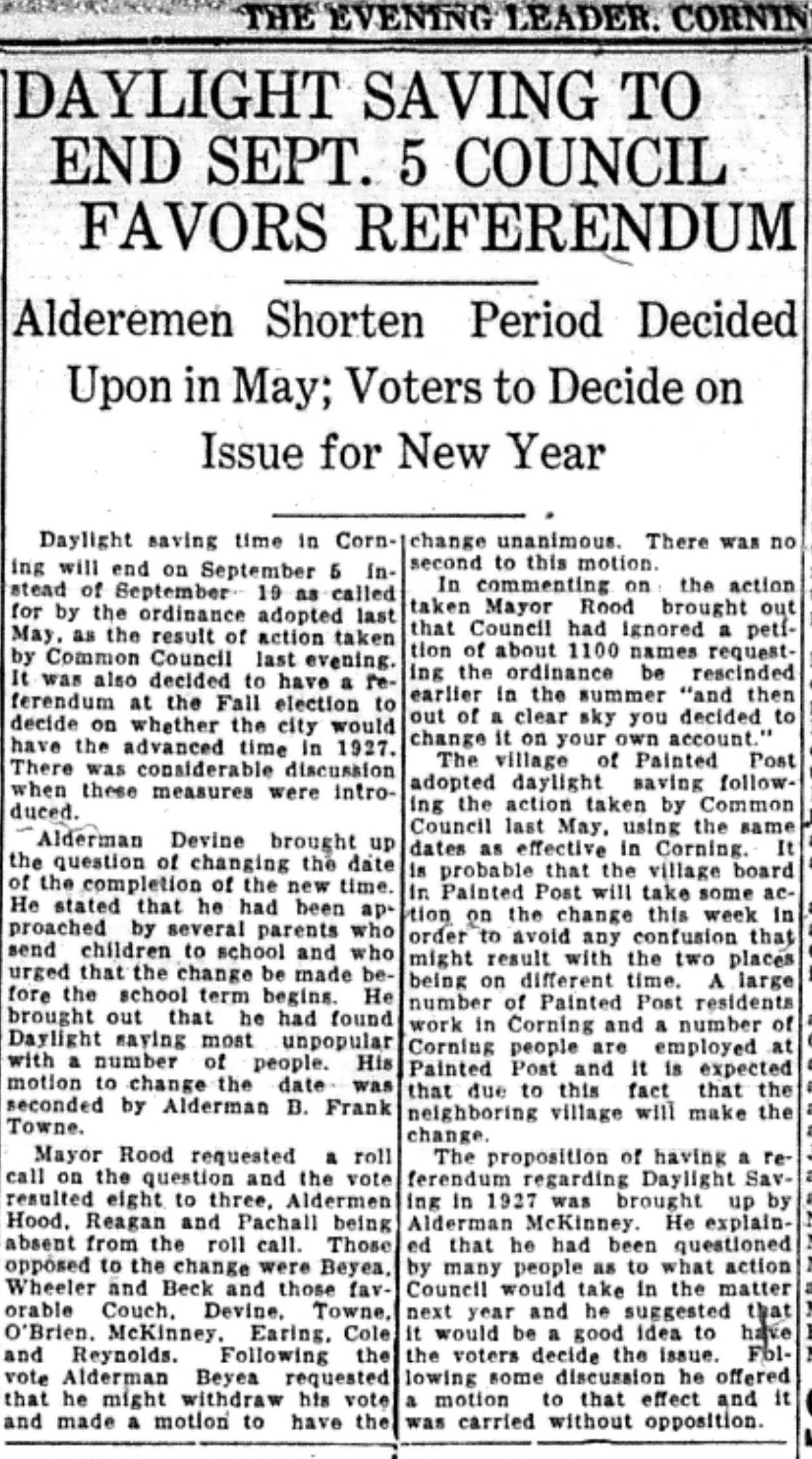
The first article is about the Corning City Council discussing the subject of daily savings time – and this was in 1926 years before the federal law – the Uniform Time Act was passed in 1966! And if you can imagine it – cities could set their own official time – and daylight savings time was a hot topic even then!
Daylight Savings To End Sept. 5 Council Favors Referendum | The Evening Leader, Corning, N.Y. | August 3, 1926
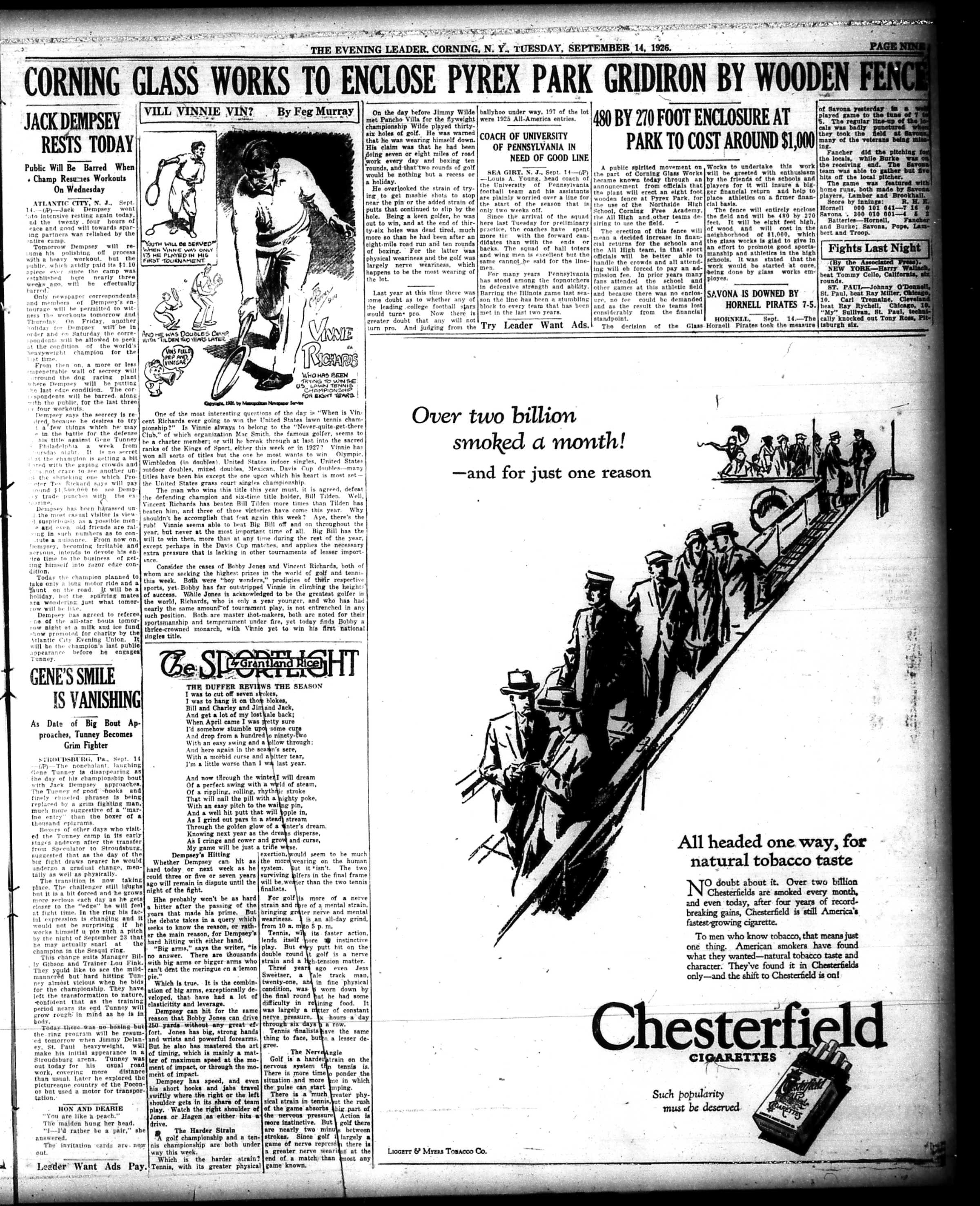
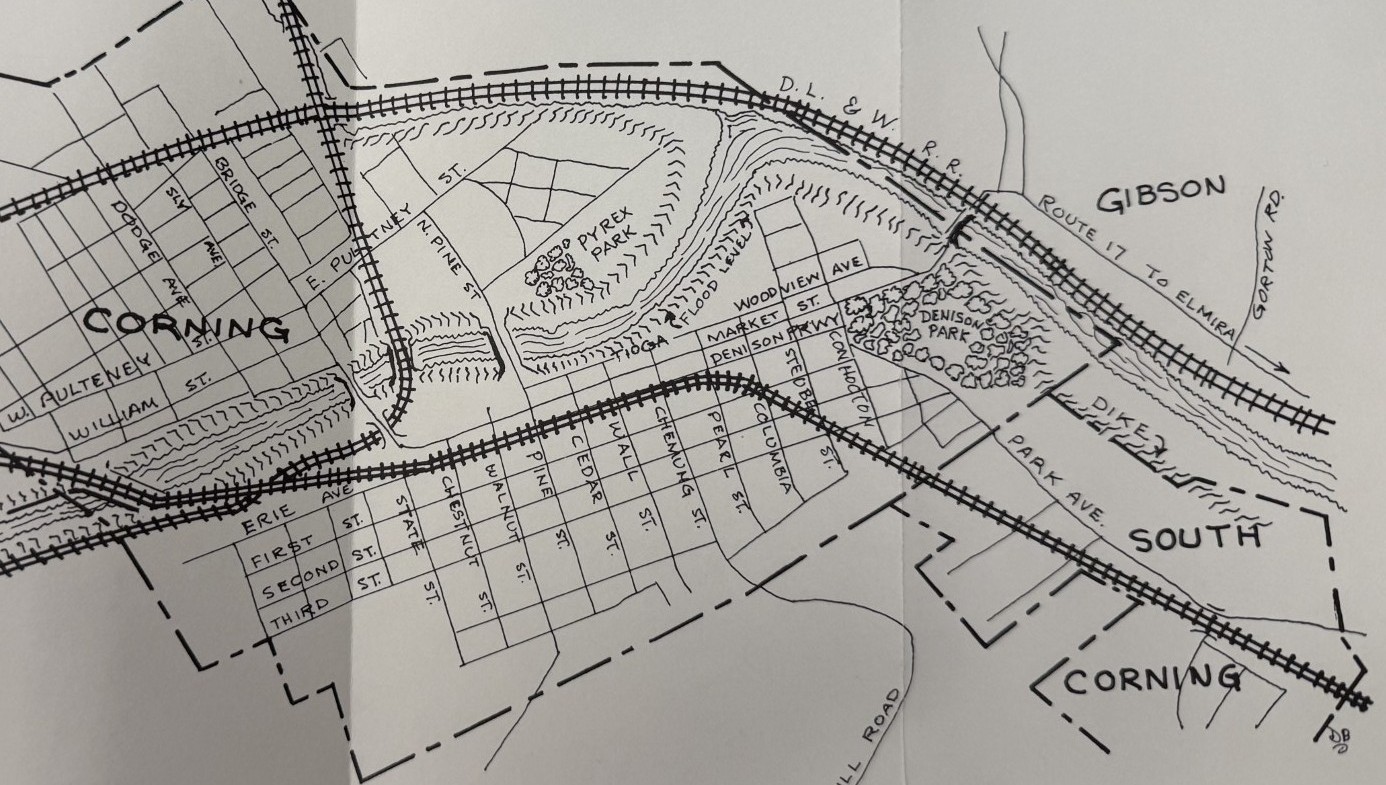
And our second vintage article is on the Glass Works plan to enclose Pyrex Park with a fence. Pyrex Park was located near the river on the Northside, near where the high school is today and the map, which is from a few years later – it is a New York State DPW map from 1947, shows where the old park was – it is gone now – but lots of baseball games were played there.
Corning Glass Works To Enclose Pyrex Park Gridiron By Wooden Fence | The Evening Leader, Corning, N.Y. | September 14, 1926
And here is a portion of the 1947 DPW map of Corning, that shows where Pyrex Park was located:
–
A Glimpse of Local Life: A Hundred Years Ago!
Here is an entire issue of The Evening Leader, Corning, N.Y. published on this day in 1926.
–
The Evening Leader, Corning, N.Y. |September 18, 1926
Heritage Quest: Heritage Quest is the library’s online genealogy service, and it includes access to census records and other research sources; it can be accessed by going to the Online Resources page, on the library’s website, and scrolling down until you see the link for Heritage Quest:
Once you’ve clicked on the Heritage Quest link, you’ll be prompted to login with your card number and PIN. If you have questions about how to use Heritage Quest, please feel free to let me know – my email address is reimerl@stls.org
–
Library Local History/Creation Station Resources: At the library you can scan your photos and slides to create digital family albums and slideshows; and even use one of the Circut machines, and other Creation Station equipment, to help you create a special paper family history album.
Also of note, we have local papers including the Corning Leader, Corning Evening Leader, Corning Journal and Corning Daily Journal, on microfilm from 1840 to the present — so you can visit the library and research local history and your family tree if you wish!
–
Local History & Newspaper blog posts are published on Fridays.
Hi everyone, and welcome to our weekly local history post!
Each week we’ll share vintage newspaper articles from years past, drawn from local publications such as the Corning Blossburg Advocate, Corning Independent,The Corning Journal, The Evening Leader, and other local newspapers. We’ll also feature the complete issue of The Corning Leader exactly 100 years to the day from each blog post. From time to time, we’ll include newly taken photographs of local historic places, landmarks, and artifacts.
–
Vintage Article of the Week
Samuel E. Quackenbush 90 Today, Can Remember Solider Of Revolution
From the Evening Leader, Corning, N.Y., April 3, 1948.
And the title of this article will for most people beg the question: Who was Samuel E. Quackenbush?
The short answer to that question is that Mr. Quackenbush really was a notable local; he was born in Caton in 1858 and went on to be the town supervisor, served as a New York State assemblyman for three terms and was mayor of the city of Corning for one term from 1922 – 1923. And if you read the short vintage article you’ll see he also liked to play cards!
Heritage Quest: Heritage Quest is the library’s online genealogy service, and it includes access to census records and other research sources; it can be accessed by going to the Online Resources page, on the library’s website, and scrolling down until you see the link for Heritage Quest:
Once you’ve clicked on the Heritage Quest link, you’ll be prompted to login with your card number and PIN. If you have questions about how to use Heritage Quest, please feel free to let me know – my email address is reimerl@stls.org
–
Library Local History/Creation Station Resources: At the library you can scan your photos and slides to create digital family albums and slideshows; and even use one of the Circut machines, and other Creation Station equipment, to help you create a special paper family history album.
Also of note, we have local papers including the Corning Leader, Corning Evening Leader, Corning Journal and Corning Daily Journal, on microfilm from 1840 to the present — so you can visit the library and research local history and your family tree if you wish!
–
Local History & Newspaper blog posts are published on Fridays.
Hi everyone, and welcome to our new weekly local history post!
Hi everyone, and welcome to our weekly local history post!
Each week we’ll share vintage newspaper articles from years past, drawn from local publications such as the Corning Blossburg Advocate, Corning Independent,The Corning Journal, The Evening Leader, and other local newspapers. We’ll also feature the complete issue of The Corning Leader exactly 100 years to the day from each blog post. From time to time, we’ll include newly taken photographs of local historic places, landmarks, and artifacts.
Vintage Article of the Week
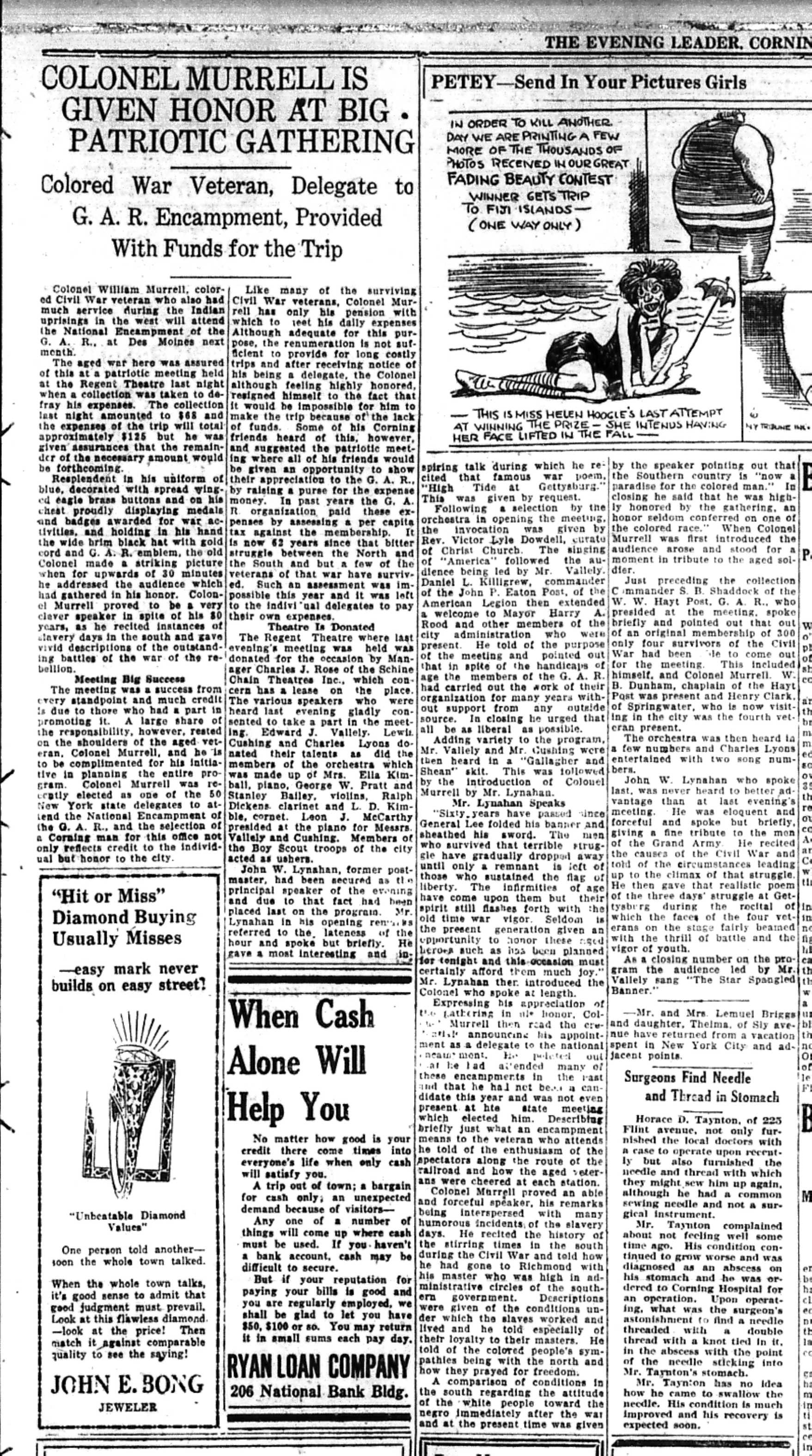
Colonel Murrell Is Given Honor At Big Patriotic Gathering
The Evening Leader, Corning, New York, August 27, 1926
And the same article as a PDF in case anyone prefers that format
About William Murrell: As a youth, William Murrell, escaped from slavery, learned to read, became a solider in the Union Army during the Civil War rising to the rank of colonel; and was later elected to the state legislature in Louisiana. He moved to our area in 1910 and is in the Steuben County Hall of Fame. He had quite the life! To learn more, check out his obituary from The Evening Leader, which was published on February 13, 1932.
Col. Murrell Historic Figure, Dies at Home from The Evening Leader, Corning, New York | February 13, 1932
Heritage Quest: Heritage Quest is the library’s online genealogy service, and it includes access to census records and other research sources; it can be accessed by going to the Online Resources page, on the library’s website, and scrolling down until you see the link for Heritage Quest:
Once you’ve clicked on the Heritage Quest link, you’ll be prompted to login with your card number and PIN. If you have questions about how to use Heritage Quest, please feel free to let me know – my email address is reimerl@stls.org
–
Library Local History/Creation Station Resources: At the library you can scan your photos and slides to create digital family albums and slideshows; and even use one of the Circut machines, and other Creation Station equipment, to help you create a special paper family history album.
Also of note, we have local papers including the Corning Leader, Corning Evening Leader, Corning Journal and Corning Daily Journal, on microfilm from 1840 to the present — so you can visit the library and research local history and your family tree if you wish!
–
Local History & Newspaper blog posts are published on Fridays.
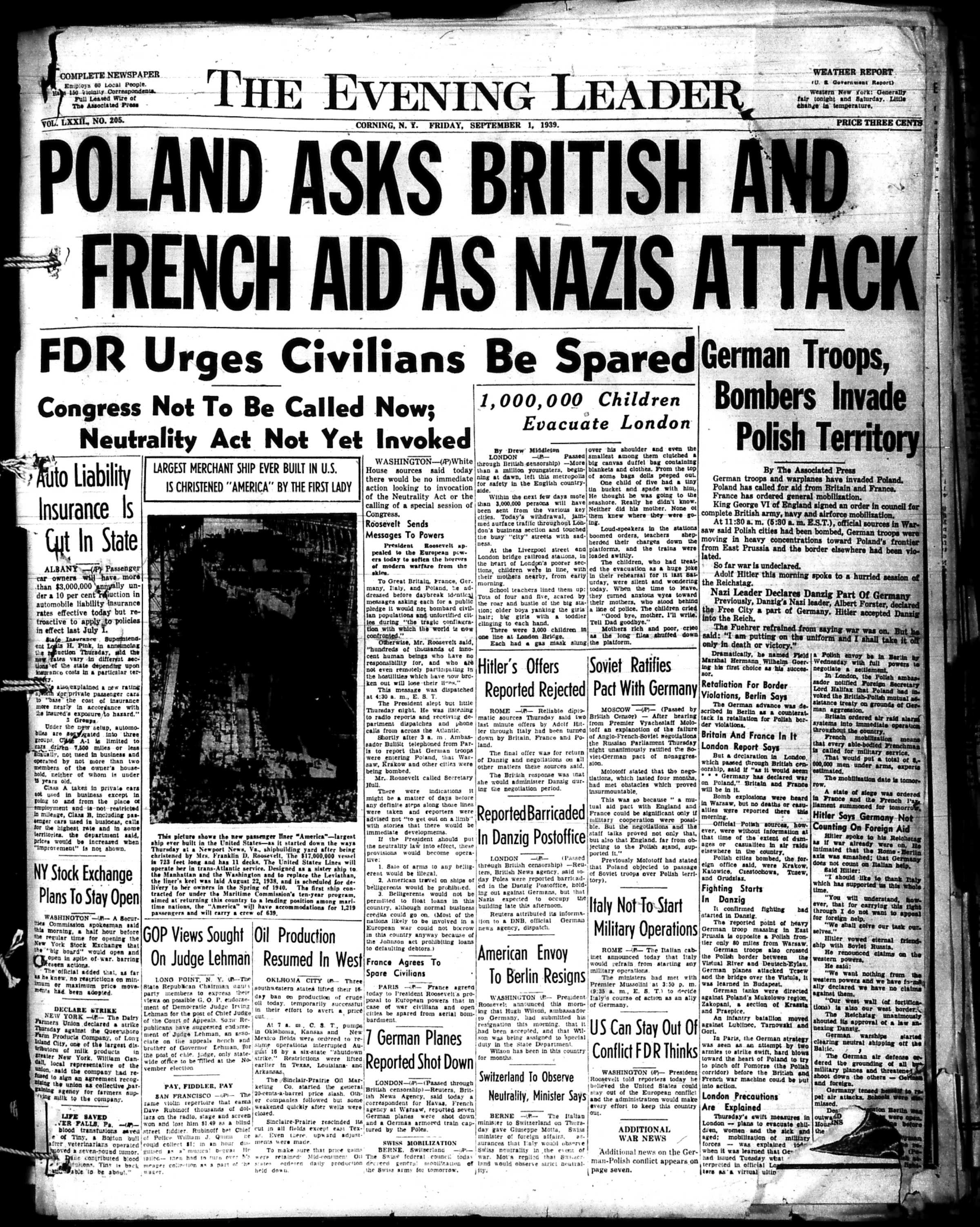
Hi everyone, as I’m sure you know today, September 1 is the anniversary of the day World War II broke out in Europe – the day that in 1939 Nazi Germany invaded Poland. And I thought I’d share The Evening Leaders for the first two days of September 1939, so we can take a look at how the news was reported locally at the time. The two leaders are combined into one PDF, following the photo of the front page of the paper for that day.
Have a great day!
Linda Reimer, SSCL
The Evening Leader Front Page, Corning, N.Y. – September 1, 1939
The Evening Leader, Corning, N.Y. | September 1 & 2, 1939